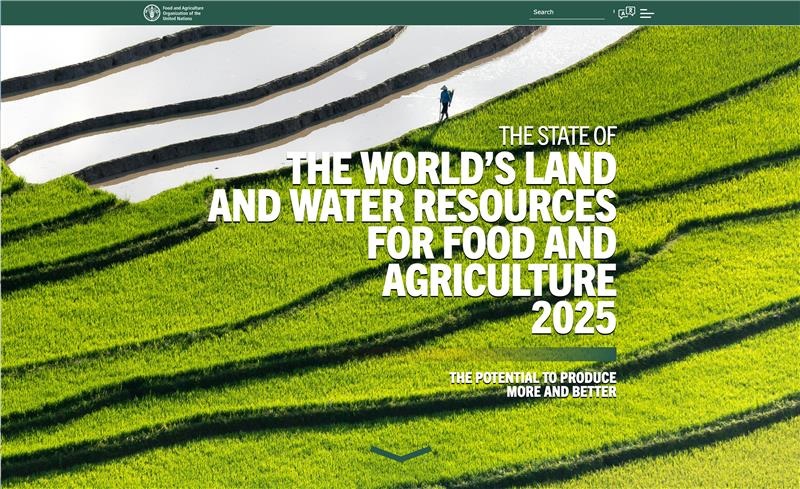
The State of the World’s Land and Water Resources for
Food and Agriculture (SOLAW) report, published by the Food and Agriculture Organization
(FAO), is a significant global study on the condition of agricultural land,
soil, and water resources. Its third edition has recently been released.
Theme The central theme of
this edition is:
¨
“The Capacity for More
and Better Production”
¨
This theme focuses on
identifying and utilizing the hidden and unused potential within global
agricultural systems.
Key Findings of the Report
¨
Current Challenges in
Natural Resource Management:In order to meet the demands of a growing global
population, Agriculture must produce 50% more food, feed and fibre by 2050 as
compared to 2012.Over 1.6 billion hectares or 10% of global land area is
degraded, mostly agricultural land.Over 60% of land degradation affects
agricultural lands, including croplands and pastures, putting immense pressure
on global food systems.
¨
Urban areas have more
than doubled between 1992 and 2015, expanding from 33 million hectares to 71
million hectares.This urban growth has consumed 24 million hectares of highly
fertile cropland, along with significant forestland and shrubland areas,
reducing available productive land.Conflicts and social instability impacted
40% of agricultural land in 2023.With 95% of food produced on land, the
combined threats of land degradation, water scarcity and extreme weather pose
significant challenges to agrifood systems, livelihoods and biodiversity.
¨
Climate change Impact on
agriculture:Climate change intensifies risks to agrifood systems through rising
temperatures, altered precipitation, droughts, and floods.Extreme weather
causes annual losses of about USD 123 billion which is 5% of global agriculture
GDP affecting food production severely.
¨
Environmental Impacts of
Agriculture:Agriculture uses one-third of Earth’s land and 72% of freshwater
resources, leading to overexploitation.Intensive farming has caused soil
depletion, pollution, and loss of biodiversity.64% of agricultural land faces
pesticide pollution, impairing resilience to pests and climate impacts.Land
degradation affects productivity and water availability, creating a vicious
cycle.
Effect
¨
Agricultural Production
Trends:From 1964 to 2023, agricultural output rose mainly through
intensification, not land expansion.Irrigated croplands are 3.2 times more
productive than rainfed lands.Global fertilizer use has increased over
four-fold since 1964.Central and Northern America and Southern Europe recorded
a net reduction in arable land between 2001 and 2023.
¨
Water Scarcity & Land
Degradation:Unsustainable farming and management practices have led to the degradation
of 996 Mha of agricultural lands which is equivalent 60% of human-induced land
degradation.1.2 billion people or about one-sixth of the global population live
in agricultural areas with severe water constraints.
¨
Constraints on Further
Expansion:Cropland may increase from 1.6 to 1.9 billion hectares by 2050, still
far less than available prime land.Further cropland expansion threatens
ecosystems like forests and wetlands, critical for biodiversity and
climate.Africa and South America have more expansion scope than Asia, which is
near its limits.
¨
Intensification and Yield
Gap:Closing the yield gap—the difference between current and potential
yields—is key to increasing production sustainably.For example, Sub-Saharan
Africa produces only 24% of potential yield on rainfed crops.Sustainable
intensification involves adopting adapted crop varieties, improved nutrient and
water management, and agroecological practices.
 Bill, 2026.jpg)