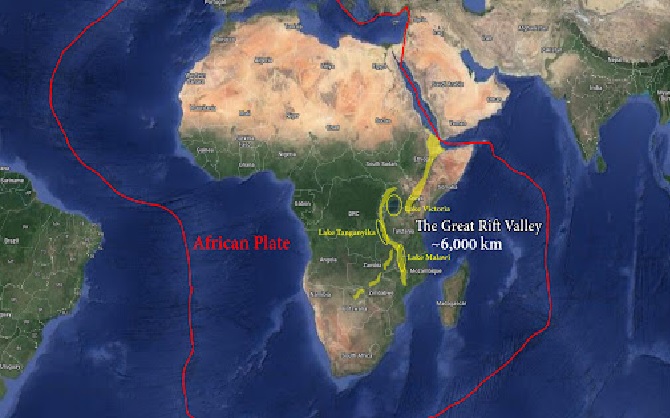
According to current geological research, the African
continent is undergoing a major geological transformation. Scientists believe
that in the long term, Africa could split into two independent landmasses. This
event would be the result of geomorphic processes occurring over millions of
years.
New magnetic data shows the African crust is slowly
but steadily splitting apart, a process that could eventually form a new ocean.The
ongoing separation is progressing from the northeast to the south in a motion
scientists liken to “the zip on a jacket”, tearing through the continent
alongside intense volcanic and seismic activity.According to current geological
timelines, the complete split is expected to occur within the next five to ten
million years.
Underlying Causes
¨
Active Afar Triple
Junction: The Afar region, where three major rifts meet, serves as the central
point of Africa’s ongoing continental breakup.
¨
Drifting Tectonic Plates:
Africa is being slowly pulled apart along the boundary between the Somalian and
Nubian Plates, while the Arabian Plate continues drifting away.
¨
The East African Rift
System, stretching from the Middle East to Mozambique, shows clear signs of
crustal thinning and stretching.
¨
Geological Heartbeat: New
research reveals rhythmic pulses of molten rock rising beneath Afar, weakening
the crust and driving the early stages of a future ocean’s formation.
Expected Changes
¨
When the process
finishes, Africa will likely exist as two distinct regions:
¨
The larger Western
landmass would contain major nations, including Egypt, Algeria, Nigeria, Ghana,
and Namibia.
¨
The Eastern landmass
would include Somalia, Kenya, Tanzania, Mozambique, and a significant portion
of Ethiopia.
¨
As the split deepens over
geological time, it is expected to cut directly through large East African
lakes such as Lake Malawi and Lake Turkana.
¨
Significance of the Study
¨
Dynamic Earth Processes:
Plate tectonics shows that continents are constantly shifting and evolving over
millions of years, highlighting the dynamic nature of Earth’s crust.
¨
Geological Risks: Rift
zones like East African Rift System and Afar face higher seismic and volcanic
activity, making geological understanding important for long-term planning and
hazard preparedness.
¨
Environmental and
Evolutionary Impact: Shifting continents and expanding seas reshape ecosystems,
climate patterns, and species distribution, influencing biodiversity and
evolution.
¨
Long-Term Geological
Change: The potential formation of a new ocean reflects Earth’s ongoing
reshaping, similar to past events like the breakup of Gondwana.
 Bill, 2026.jpg)