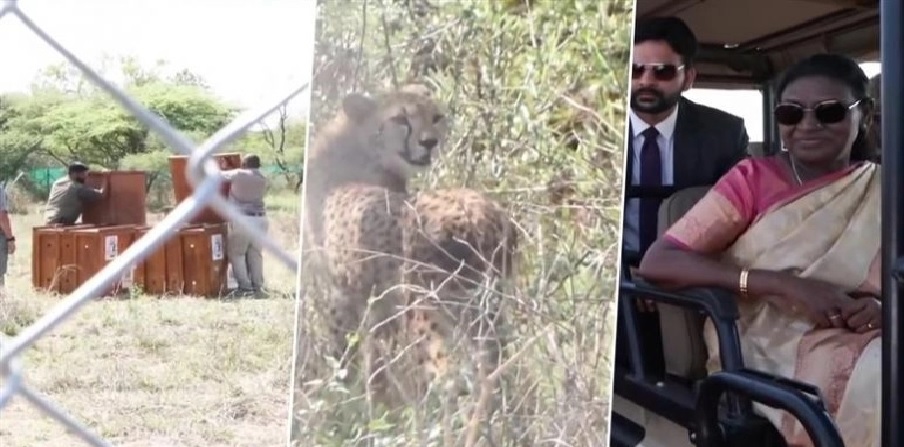
During the President
of India’s state visit to Botswana, the country formally announced the
translocation of eight cheetahs to India as a part of Project Cheetah.
Translocation So Far
¨
In September 2022, eight cheetahs from Namibia were brought to a special
enclosure in Kuno National Park, Madhya Pradesh, marking the world’s first
intercontinental translocation of a large wild carnivore.
¨ In February 2023, twelve more cheetahs from
South Africa joined them in India.
¨ As part of the latest translocation, Botswana
has handed over eight additional cheetahs, currently undergoing quarantine at
the Mokolodi Reserve and expected to reach India in the coming weeks.
¨ India now has 27 cheetahs, including 16 born
on Indian soil.
¨ 24 Cheetahs are at Kuno National Park.
¨
3 Cheetahs are at the Gandhi Sagar Wildlife Sanctuary (GSWS).
Since the project began
¨
19 cheetahs (9 imported adults + 10 India-born cubs) have died due to
various causes.
¨ 26 cubs have been born in Kuno so far.
¨ After importing 20 African cheetahs (Namibia
+ South Africa), India currently has a net gain of 7 cheetahs over the initial
number.
¨
Nauradehi Wildlife Sanctuary in Madhya Pradesh is being developed as
India’s third site for cheetahs.
Project Cheetah
¨
Launched in September 2022, the project aims to reintroduce cheetahs,
which became extinct in India in 1952, and restore their ecological role in
grassland and open forest ecosystems.
¨
It is the world’s first intercontinental translocation of a large wild
carnivore species, focusing on establishing a self-sustaining, free-ranging
cheetah population.
About Cheetah
¨
It is the only large carnivore species that went extinct in Independent
India.
¨
Cheetahs thrive in open grasslands, savannas, and arid areas where they
can use their speed to hunt prey like gazelles and antelope.
African Cheetah
¨
The African cheetah has a slender, long-legged body with a tawny to
creamy white coat covered in evenly spaced black spots.
¨
IUCN status: Vulnerable
Asiatic Cheetah
¨
The Asiatic cheetah is slender, with buff-to-light fawn-coloured fur and
distinctive black spots arranged in lines on the head and nape.
¨
IUCN status: Critically Endangered
Implementation agencies
¨
National Tiger Conservation Authority (NTCA)
¨ Wildlife Institute of India (WII)
¨
Madhya Pradesh Forest Department
International cheetah experts
¨
The project integrates habitat restoration, biodiversity conservation,
ecotourism, and community involvement, including awareness programmes and
conflict mitigation.
Significance of Re-introducing Cheetahs in India
¨
Restoration of a keystone predator: Helps regulate herbivore
populations, preventing overgrazing and maintaining vegetation health.
¨ Strengthening grassland ecosystems: Cheetahs
serve as a flagship species for the conservation of India’s neglected
grasslands, scrublands, and open forests.
¨ Promoting trophic cascades: Their presence
can trigger positive cascading impacts across the food chain, enhancing
biodiversity and ecological resilience.
¨ Supporting other endangered species:
Protection measures for cheetah habitats benefit other threatened fauna sharing
the same landscapes.
¨
Boosting local livelihoods: Ecotourism and community-led conservation
can generate sustainable employment and economic diversification for local
communities.
 Bill, 2026.jpg)