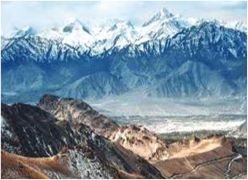
HKH Snow Update: Record Decline in Snow
Stability in 2026 Heightens Concerns Over Water Crisis
Hindu Kush Himalaya (HKH) Snow Update 2026 by the
International Centre for Integrated Mountain Development reports a record
decline in snow persistence, raising concerns over a regional water crisis.
About the Report
¨
The HKH Snow Update 2026
is an annual assessment of seasonal snow anomalies across the Hindu Kush
Himalaya region during the winter months (November–March).
¨
It defines snow
persistence as the fraction of time snow remains on the ground after snowfall,
a key indicator of mountain water reserves.
¨ The report analyses snow
conditions across 12 major river basins, which collectively support nearly two
billion people through water supply, agriculture, and hydropower.
¨
Snowmelt contributes
about 23–25% of annual river runoff, making seasonal snow crucial for early
summer water availability, especially in western basins.
Key Findings of the Report
¨ Record Decline in Snow
Persistence:Snow persistence in the 2025–26 winter was 27.8% below the
long-term average, the lowest in over two decades. This surpasses the previous
record deficit of 23.6% (2024–25). It marks the fourth consecutive year of
below-normal snow persistence and reflects a recurring long-term trend (14 such
winters since 2003).
¨
Basin-wise Variations:
Snow persistence was below normal in 10 out of 12 river basins.Above-average
snow persistence was recorded only in the Ganga Basin (+16.3%) and the
Irrawaddy Basin (+21%). The sharpest declines were observed in the Mekong Basin
(–59.5%), the Tibetan Plateau (–47.4%), and the Salween Basin (–41.8%).
¨
High Dependence on
Snowmelt:Snowmelt contributes significantly to river flow, particularly in
western basins such as the Amu Darya (~74.4%), Helmand (~77.5%), Indus
(~39.7%), and Tarim (~23.9%). The declining snow levels therefore pose a
serious threat to water availability in these regions.
¨
Implications for Water
Security: Reduced snow persistence leads to lower early summer river runoff,
increased groundwater extraction, and a higher risk of droughts. These impacts
extend downstream, affecting agriculture, hydropower generation, and
livelihoods.
¨ Climate Change Link and
Cryosphere Stress:HKH glaciers are melting twice as fast since 2000, indicating
accelerating cryospheric loss. The region, known as the “Water Tower of Asia”,
holds over 60,000 glaciers and ~6,000 cubic km of ice.


 Extended.jpg)