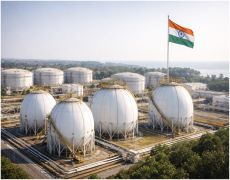
India's petroleum reserves are strong,
with two-thirds of its capacity used for emergencies
According to a recent statement by the Ministry of
Petroleum and Natural Gas (MoPNG), India's Strategic Petroleum Reserves (SPRs)
currently hold approximately two-thirds of their total storage capacity.
Other Relevant Information
¨
The total crude oil
storage capacity of India's Strategic Petroleum Reserves (SPRs) stands at 5.33
million tonnes. Currently, these reserves hold 3.37 million tonnes of oil,
representing 64% of the total capacity.
¨
These strategic petroleum
reserves of India are housed in three underground rock cavern facilities
located in Andhra Pradesh and Karnataka. At full capacity, these three SPRs can
meet approximately 9.5 days of India's crude oil supply requirements.
¨
The purpose of these SPRs
is to serve as a buffer against short-term supply shocks. These reserves are
currently a subject of intense discussion due to disruptions in India's energy
supply caused by the ongoing conflict in West Asia.
What are Strategic Petroleum Reserves
(SPRs)?
¨ Strategic Petroleum Reserves
(SPRs) are large government-held stockpiles of crude oil established to provide
security against sudden supply disruptions, conflicts, or sharp fluctuations in
prices.
¨
The concept of dedicated
strategic reserves was first proposed in 1973, following the first oil crisis.
Strategic reserves in Western nations have
been utilized during the following major events:
¨
During the First Gulf War
(1991).
¨ Following Hurricane
Katrina (2005). In 2022, global oil prices witnessed a massive surge following
Russia's invasion of Ukraine. Countries such as the United States (US), China,
and Japan maintain vast strategic petroleum reserves. The US possesses an oil
reserve of 727 million barrels, while China's storage capacity exceeds 1,200
million barrels. Current Scenario: Members of the International Energy Agency
(IEA) recently decided to release 400 million barrels of oil from their
emergency reserves. This decision was taken in light of the supply disruptions
and the massive surge in oil prices resulting from the conflict in West Asia.
Strategic Petroleum Reserve (SPR)
Infrastructure in India
¨ Strategic petroleum
reserves in India are managed by Indian Strategic Petroleum Reserve Limited
(ISPRL). It is a wholly-owned subsidiary of the Oil Industry Development Board
(OIDB)—under the Ministry of Petroleum and Natural Gas—functioning as a Special
Purpose Vehicle (SPV).
India's Storage Facilities: Currently, the
country has established underground rock cavern storage facilities at three
locations
¨
Visakhapatnam – 1.33 million
tonnes
¨
Mangaluru – 1.50 million
tonnes
¨
Padur – 2.50 million
tonnes
In July 2021, the government approved the
development of two additional commercial-cum-strategic reserves with a total
capacity of 6.5 million tonnes:
¨
Chandikhol (Odisha) – 4.0
million tonnes
¨
Padur (Expansion) – 2.5
million tonnes
Additionally, proposals for new Strategic Petroleum
Reserve (SPR) facilities in Bikaner and Rajkot are under consideration, which
could further augment India's SPR capacity by approximately 6 million tonnes.
Recent Developments: Megha Engineering and
Infrastructures Limited (MEIL) has won the bid process conducted by Indian
Strategic Petroleum Reserves Limited (ISPRL) to construct and operate India's
first private-sector Strategic Petroleum Reserve in Padur, Karnataka.
India's Total Oil and Fuel Reserves
¨
India is the world's
third-largest consumer of crude oil and relies on imports to meet over 88% of
its requirements.
¨ The International Energy
Agency (IEA) recommends that countries maintain oil reserves equivalent to at
least 90 days of their net oil imports; however, the current total national
storage capacity for crude oil and petroleum products stands at 74 days
(including commercial stocks held by refineries), which still falls short of
these recommendations.
Significance of SPRs
¨
Energy Security and
Strategic Buffer: Strategic Petroleum Reserves serve as a crucial safety net
against supply disruptions caused by geopolitical tensions (such as conflicts
in West Asia or risks associated with the Strait of Hormuz). They ensure a
continuous supply of fuel during emergencies.
¨
Price Stabilization and
Economic Security: By ensuring a controlled release of crude oil during periods
of extreme price volatility, SPRs help regulate domestic fuel prices. This
safeguards the economy against inflationary shocks.
¨ Meeting Global Energy Security Standards: Strategic Petroleum Reserves contribute to meeting the International Energy Agency's (IEA) standard of maintaining a 90-day net import cover. This enhances India's strategic preparedness and global credibility.
¨ Resilience and Supply Diversification: Large reserves facilitate bulk purchasing at favorable prices, enable the diversification of import sources, and provide enhanced bargaining power. Furthermore, private sector participation improves operational efficiency and reduces the fiscal burden on the government exchequer.
 Bill, 2026.jpg)