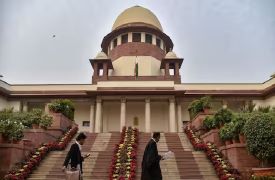
Supreme Court's Landmark Verdict on the
Definition of Scheduled Castes
In a significant ruling, the Supreme Court has
clarified that an individual professing a religion other than Hinduism,
Buddhism, or Sikhism cannot be deemed a member of the Scheduled Caste (SC)
community. This verdict addresses issues pertaining to the constitutional
definition of Scheduled Castes and their associated rights.
Key Highlights of the Judgement
¨ The Supreme Court
reaffirmed that, under Clause 3 of the Constitution (Scheduled Castes) Order,
1950, Scheduled Caste status is restricted to persons “professing” Hinduism,
Sikhism, or Buddhism, and is lost upon conversion to other religions.
¨ The Court held that
conversion results in an “immediate and complete loss” of SC status,
irrespective of one’s birth in a Scheduled Caste community.
¨ It clarified that the
term “profess” implies openly declaring and practising a religion, making
religious identity a matter of public expression, not merely private belief.
¨
On reconversion back to
Hindu, Sikh or Buddhist religions, the SC held that an individual must
conclusively prove original caste, demonstrate genuine re‑conversion, and
secure acceptance by the relevant caste community.
Reasons for Denial of SC Status to Dalit
Christians
¨
The Registrar General of
India (RGI) has historically opposed expanding SC status beyond Hindus and
Sikhs and stated that the SC status is intended for communities facing social
disabilities arising from “untouchability”, which is primarily prevalent in
Hindu and Sikh communities.
¨
In 2001, the RGI
reiterated its opposition, stating Dalit Christians and Muslims do not form a
single ethnic group, which is required under Article 341 of the Indian
Constitution.
¨ Conversion leads to loss
of caste identity, and untouchability is not practised in their new religious
communities.
Constitutional and Legal Framework for the
Scheduled Caste
¨ Article 15(4): Empowers
the State to make any special provision for the advancement of any socially and
educationally backward classes of citizens or for SCs and STs.
¨
Article 17: Abolishes
Untouchability.
¨ Article 46: Mandates the
state to give special emphasis to advancing the educational and economic
interests of weaker sections, particularly Scheduled Castes and Scheduled
Tribes, while protecting them from social injustice and exploitation.
¨
Article 330 and Article
332: Provide for the reservation of seats for SCs and STs in the Lok Sabha and
the State Legislative Assemblies.
¨ Article 341(1): Empowers the President to specify which castes, races, or tribes (or groups within them) are deemed Scheduled Castes (SC) for a particular State or Union Territory.
¨ Article 341(2): Empowers Parliament, rather than state governments, to pass laws that include in or exclude from the list of Scheduled Castes (SCs) any group, race, or tribe specified by the President.
 Bill, 2026.jpg)