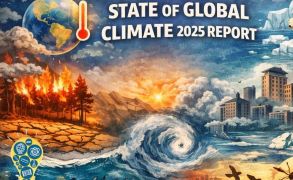
WMO’s ‘State of the Global Climate Report
2025’: A Looming Threat to the Climate System
On March 23, on the occasion of World Meteorological
Day, the World Meteorological Organization (WMO) released its highly
anticipated ‘State of the Global Climate Report 2025’. Highlighting the dire
state of the global climate, the report warns that the Earth's climate system
has reached a state of emergency due to unprecedented warming and energy
imbalance.
About the Report
¨ The State of the Global
Climate is an annual flagship report of WMO that provides an authoritative
assessment of the global climate system.
¨
It compiles scientific
inputs from National Meteorological and Hydrological Services, WMO Regional
Climate Centres, UN agencies, international data centres, and climate experts.
¨
The report updates key
climate indicators such as temperature, greenhouse gases, ocean heat, sea
level, and cryosphere changes.
¨
It also documents major
extreme weather events and their socio-economic impacts, including effects on
health, food security, and displacement.
¨
The 2025 edition
introduces Earth’s Energy Imbalance as a key indicator, reflecting advances in
climate science and monitoring.
Key Findings of the Report
¨
Record-Breaking Warming
Trends: The period 2015–2025 constitutes the 11 hottest years on record. 2025
was among the top three warmest years, about 1.43°C above pre-industrial
(1850–1900) levels. Warming persists despite cooling influences like La Niña,
indicating strong long-term warming trends.
¨
Rising Greenhouse Gas
Concentrations: Atmospheric carbon dioxide levels are ~50% higher than
pre-industrial levels. CO₂, methane, and nitrous oxide have reached their
highest levels in at least 800,000 years. Continued fossil fuel use and
weakening natural carbon sinks are driving record emissions.
¨
Earth’s Energy Imbalance
at Record High: For the first time, the report highlights Earth’s Energy
Imbalance as a core indicator. It measures the difference between incoming
solar energy and outgoing heat. This imbalance is now the highest in a 65-year
record, showing that excess heat is accumulating in the Earth system.
¨
Oceans (Major Heat and
Carbon Sink): Oceans absorb over 90% of excess heat and act as a climate
buffer. Ocean heat content reached a record high in 2025, with warming rates
doubling since 2005. Oceans have absorbed energy equivalent to ~18 times annual
human energy use each year for two decades.
¨
Increased CO₂ absorption
is causing ocean acidification, threatening marine ecosystems.
¨
Accelerating Sea-Level Rise:
Global mean sea level is now ~11 cm higher than in 1993. The rate of sea-level
rise has accelerated in recent years, driven by ocean warming and ice melt.
This leads to coastal flooding, ecosystem damage, and groundwater salinization.
¨
Cryosphere Under Severe
Stress: Arctic Sea ice is at or near record lows, while Antarctic Sea ice is
among the lowest recorded. Glacier mass loss is accelerating, with some of the
worst losses occurring in recent years. Ice sheets in Greenland and Antarctica
continue to lose mass, contributing to sea-level rise.
¨
Intensification of
Extreme Weather Events: Climate change is increasing the frequency and
intensity of extreme events such as heatwaves, heavy rainfall and floods,
tropical cyclones and storms and wildfires, and droughts.These events caused
thousands of deaths, affected millions, and led to billions in economic losses.
They also expose the vulnerability of interconnected global economies.
¨
Climate Impacts on
Society, Health, and Economy: Climate change is adversely affecting
livelihoods, ecosystems, and health systems by increasing risks of vector- and
water-borne diseases, mental stress, and widespread heat exposure, with over
one-third of the global workforce facing heat-related productivity losses.
¨
Food Security,
Displacement, and Systemic Risks: Extreme weather events are triggering
cascading impacts on agriculture, food security, and migration, leading to
large-scale displacement and heightened vulnerability, especially in fragile
and conflict-affected regions.
¨
Long-Term and
Irreversible Changes: Many climate impacts, particularly ocean warming,
sea-level rise, and acidification, are irreversible over centuries to
millennia, locking in long-term consequences for the planet.
¨ Urgent Need for Climate
Action: The report highlights the urgent need for rapid emission reductions,
transition away from fossil fuels, and achievement of net-zero targets to
prevent further escalation of climate risks.


 Extended.jpg)