First Criticality of Kalpakkam PFBR: A
Milestone in India’s Nuclear Energy
¨ India has achieved a
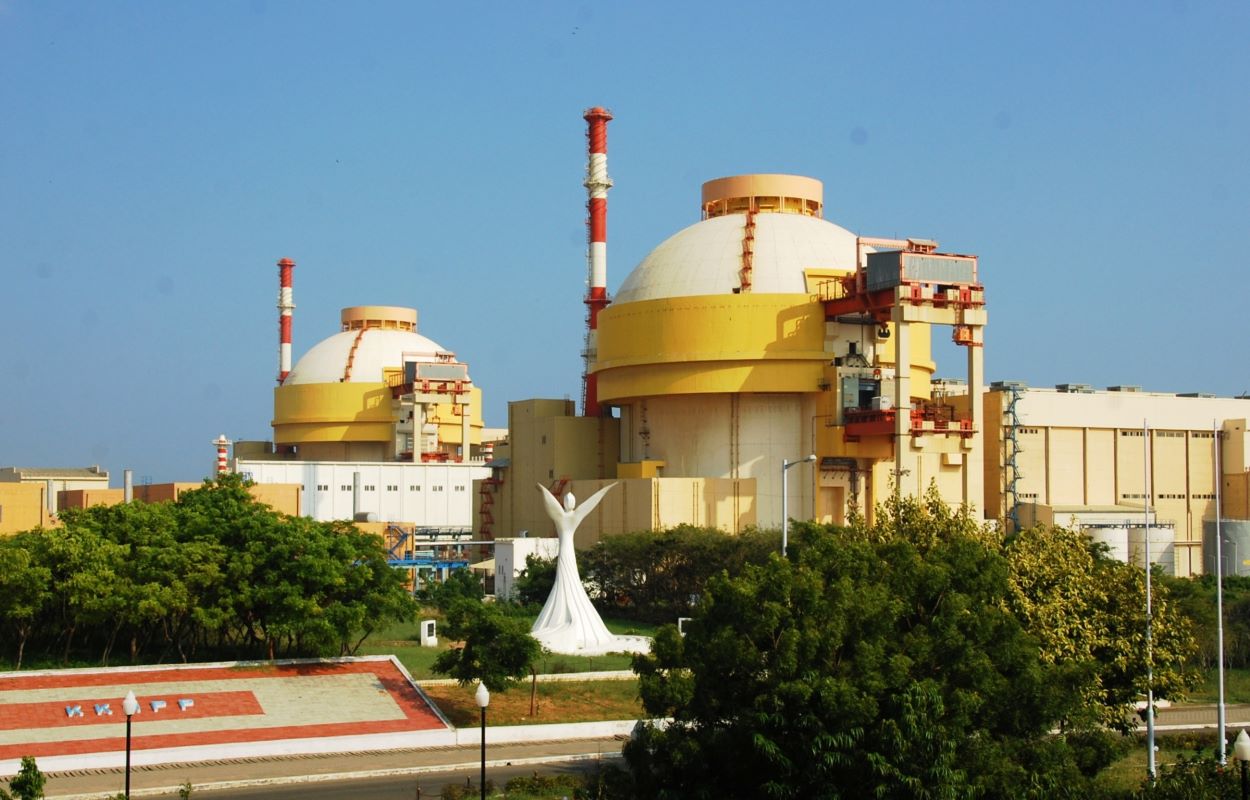
significant milestone in its nuclear energy journey with the 500 MWe Prototype
Fast Breeder Reactor (PFBR) at Kalpakkam, Tamil Nadu attaining ‘First
Criticality’. This marks the beginning of a controlled nuclear chain reaction,
a crucial step toward full-scale power generation. This signifies the progress
achieved in the second stage of India's three-stage nuclear power program. This
achievement paves the way for India's journey toward long-term energy security,
self-reliance in nuclear fuel, and a clean energy transition.
Kalpakkam PFBR Project
¨The PFBR is a
500-megawatt (MWe) capacity, sodium-cooled, pool-type Fast Breeder Reactor,
designed by the Indira Gandhi Centre for Atomic Research (IGCAR) and
constructed by the Bharatiya Nabhikiya Vidyut Nigam Limited (BHAVINI). Both
these institutions function under the Department of Atomic Energy (DAE).
¨ The reactor has achieved
'criticality' (a controlled chain reaction) after fulfilling all safety
requirements and obtaining clearances from the Atomic Energy Regulatory Board
(AERB).
¨ Approved in 2003 and
initiated in 2004, this project took over two decades to reach criticality due
to technical complexities. Following core loading in March 2024 and fuel
loading in October 2025, it finally achieved criticality in April 2026.
¨ Due to delays and
technical issues, the project's cost escalated from approximately ₹3,492 crore
to nearly ₹7,600 crore. Inefficiencies in procurement processes were also
highlighted by the Comptroller and Auditor General (CAG) of India.
¨
With the PFBR, India is
poised to become the second country in the world—after Russia—to operate a
commercial Fast Breeder Reactor.
¨ In countries such as
Japan, France, and the United States, Fast Breeder Reactor programs have been
curtailed due to safety and economic concerns.
Prototype Fast Breeder Reactor (PFBR)
¨
The PFBR is a nuclear
reactor that produces more fuel than it consumes.
¨ It is a 'Fast Breeder'
reactor, meaning that it generates additional fissile material during its
operation. • Its ‘core-loading’
constitutes a significant achievement, as it marks the formal commencement of
the second stage of India’s three-stage nuclear program.
¨ BHAVINI: In 2003, the
Department of Atomic Energy (DAE) established a ‘Special Purpose Vehicle’ named
the ‘Bhartiya Nabhikiya Vidyut Nigam Limited’ (BHAVINI) to implement the second
stage of the nuclear program.
¨
Role in India’s
Three-Stage Nuclear Program
¨ This three-stage program
was designed by Dr. Homi J. Bhabha, given that India possesses approximately
one-quarter of the world's thorium reserves.
¨
Stage I – PHWRs: India
utilized Pressurized Heavy Water Reactors (PHWRs) and natural Uranium-238
(U-238), which contains a small quantity of U-235 acting as the fissile
material.
¨
In a PHWR, heavy water
slows down the speed of neutrons sufficiently to allow them to be absorbed by
U-238 and U-235 nuclei, thereby initiating a new fission process.
¨
These reactions result in
the production of energy as well as Plutonium-239 (Pu-239).
¨
Stage II – PFBR: Only
Uranium-235 (U-235) can sustain a chain reaction—unlike U-238—and the U-235 is
consumed during the first stage.
¨
In the second stage,
India utilizes U-238 alongside Pu-239 in a PFBR to generate energy,
Uranium-233, and larger quantities of Pu-239.
¨ Stage III – Thorium-based
Reactors: In the third stage, Pu-239 is mixed with Thorium-232 (Th-232) in
reactors to generate energy and Uranium-233.
¨ With the completion of
these three phases, there is a possibility of achieving complete self-reliance
in the country's nuclear energy sector.
 system.jpg)