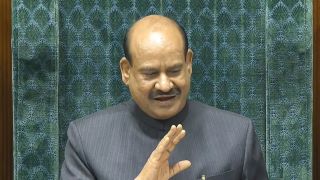
Opposition files notice of no-confidence
motion against Lok Sabha Speaker Om Birla
In a major development in parliamentary politics,
opposition parties have filed a notice of no-confidence motion against Lok
Sabha Speaker Om Birla under Article 94(c) of the Constitution. This move comes
amid growing tensions between the ruling party and the opposition during the
current session of Parliament. The opposition alleges that the Speaker has not
maintained impartiality in conducting the proceedings of the House and that the
opposition's voice has not been given adequate weight. Several opposition
leaders claimed that discussions on important issues were not allowed and that
there was bias in the interpretation of rules.
This is not the first time that the opposition has
decided to bring a No-Confidence Motion against the presiding officer of
Parliament. Earlier in 2024, the opposition had brought a similar motion
against the then Rajya Sabha Chairman and Vice-President Jagdeep
Dhankhar.Congress MP and Leader of Opposition in the Lok Sabha Rahul Gandhi has
not signed the notice of the No-Confidence Motion brought by opposition parties
against Lok Sabha Speaker Om Birla.
Total 118 Member of Parliaments (MPs)
signed the No-Confidence Motion
¨
Congress Member of
Parliament (MP) Gaurav Gogoi said that the notice was formally submitted at
1:14 PM under Rule 94C of the Rules of Procedure and Conduct of Business in the
Lok Sabha.
¨
Congress said that a
total of 118 MPs have signed the notice.
¨
The motion has the
support of parties including Congress, Samajwadi Party and Dravida Munnetra
Kazhagam (DMK). However, Trinamool Congress (TMC) has not yet signed the
notice.
Reason for the No-Confidence Motion
¨
In the notice, opposition
MPs alleged that the Speaker did not continuously allow them to raise issues of
public importance.
¨
They listed several
complaints, including not allowing Rahul Gandhi to speak during the debate on
the Motion of Thanks on the President’s Address, suspending opposition MPs, and
not taking any action against BJP MP Nishikant Dubey for his comments against
former Prime Ministers.
¨
Senior Congress leader
K.C. Venugopal had accused the Speaker of bias and indicated early action. He
said that despite parliamentary convention, the Leader of Opposition is not
being allowed to speak in the House.
Other examples in the history of
No-Confidence Motions
¨
In history, since
independence, at least three such instances have been recorded when a
No-Confidence Motion was brought to remove the Speaker. The first was in 1954
against the first Lok Sabha Speaker, G.V. Mavalankar, when MP Vigneshwar Mishra
alleged that the Speaker was not impartial.
¨
In 1966, the opposition
presented a motion against Speaker Sardar Hukam Singh, led by Madhu Limaye, and
Deputy Speaker S.V. Krishnamurthy Rao was in the Chair.
¨
The third motion was
presented on 15 April, 1987 by CPM MP Somnath Chatterjee to remove Speaker
Balram Jakhar, and it was presided over by Deputy Speaker Thambi Durai. The
House rejected this motion.
Article 94(C) related to No-Confidence
Motion
¨
In the Constitution,
Article 94(C) describes the process of bringing a No-Confidence Motion against
the Lok Sabha Speaker.
¨
The Constitution states,
"A member holding office as Speaker or Deputy Speaker of the House of the
People may be removed from his office by a resolution of the House of the
People passed by a majority of all the then members of the House of the
People."
¨
It further states,
"Provided that no resolution for the purpose of clause (c) shall be moved
unless at least fourteen days’ notice has been given of the intention to move
the resolution."
Procedure under Article 94(C) related to
No-Confidence Motion
¨
According to the Rules of
Procedure and Conduct of Business in the Lok Sabha, any member of the House may
demand the removal of the Speaker. Under Chapter 18 of the rulebook, the member
must give a written notice to the Secretary-General of the House along with the
full text of the resolution.
¨
Once the notice is
received, the motion seeking permission to move the resolution is entered in
the List of Business in the name of the member who gave the notice.
¨
The date for moving the
motion is decided by the Chair -- usually the Deputy Speaker, because when a
motion to remove him is brought, the Speaker cannot preside over the House.
¨ Then the Chair places the motion before the House and asks whether permission should be granted to move it. After the motion is placed before the House, at least 50 members must stand in its support. If this limit is not met, the motion fails and the member who moved it is informed accordingly.
¨ If the motion is accepted, voting takes place. Voting may be by voice vote, division of votes or other prescribed methods.
 Bill, 2026.jpg)