Scientists claim: Earth's magnetic field
reversal lasts longer than expected
A recent study published in Communications Earth &
Environment suggests that Earth’s magnetic field reversals may last far longer
than previously assumed.
Earth’s Magnetic Field and Geomagnetic
Reversals
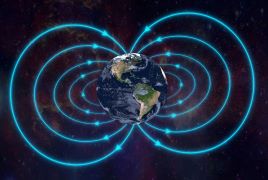
¨ Earth’s magnetic field
helps in navigation and forms the magnetosphere, protecting the planet from
harmful solar wind and cosmic radiation.
¨
The field is generated
through the geodynamo process, caused by the movement of molten iron and nickel
in Earth’s outer core (~2,200 km thick).
¨
Over geological time, the
magnetic north and south poles periodically reverse, a phenomenon known as
geomagnetic reversal.
¨
Evidence of past
reversals is preserved in rocks and marine sediments, where magnetic minerals
(such as magnetite crystals) align with the Earth’s magnetic field when
deposited.
¨
Scientists estimate that
around 540 geomagnetic reversals have occurred over the past 170 million years.
¨
Earlier studies suggested
that reversals generally occur over 2,000–12,000 years, with about 10,000 years
considered the typical duration.
Findings of the New Study
¨
An international team of
researchers from Japan, France, and the United States, led by Yuhji Yamamoto
(Kochi University) and Peter Lippert (University of Utah), analyzed deep-sea
sediment cores from the North Atlantic near Newfoundland, Canada.
¨ These sediments were
collected during the Integrated Ocean Drilling Program expedition (2012).
The researchers examined sediment layers
from the Eocene epoch (~40 million years ago) using
¨
X-ray scanning
¨
Magnetic measurements
¨
Astronomical tuning of
sediment layers
Their analysis identified two unusually
long geomagnetic reversals
¨
One lasting about 18,000
years
¨
Another lasting around
70,000 years
The longer reversal showed complex behaviour,
including precursor phases and multiple rebounds, where the magnetic field temporarily
shifted direction before stabilizing.Numerical simulations of the Earth’s core
suggested such long reversals are rare but natural outcomes of geodynamo
dynamics, potentially lasting up to 130,000 years.
Implications for Earth and Future Research
¨
During geomagnetic
reversals, the magnetic field weakens significantly, reducing Earth’s
protection from solar and cosmic radiation.
Prolonged reversals could therefore lead
to
¨
Higher radiation exposure
¨
Increased genetic
mutations
¨
Possible atmospheric
erosion
Disruption of animal navigation, since many species
rely on Earth’s magnetic field.
Such conditions may have influenced ancient ecosystems
and evolutionary processes.The Eocene period, when these long reversals
occurred, also had higher global temperatures and CO₂ levels, making it a
useful climate analogue for future warming scenarios.Scientists note that
Earth’s magnetic field strength has declined by about 5% per century in recent
measurements, while the magnetic North Pole continues to drift toward Siberia,
raising questions about whether a future reversal could eventually occur.Future
research will analyze lava sequences in Iceland and geomagnetic excursions
preserved in sediment records better to understand the causes and duration of
magnetic reversals.
 Bill, 2026.jpg)