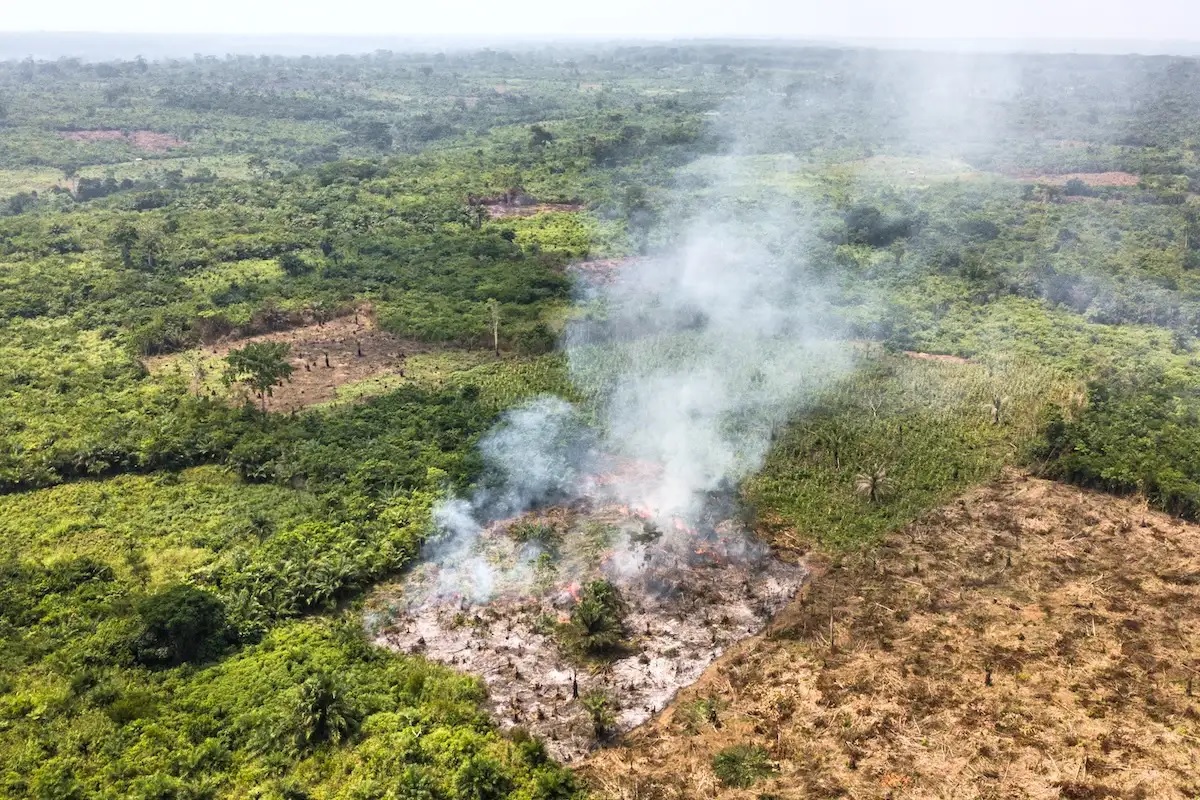
Climate change is one of the biggest challenges facing
the world today. The Earth's forests, vegetation, and oceans have long acted as
carbon sinks, absorbing carbon dioxide from the atmosphere. However, a recent
study has forced the scientific community to rethink this.According to this
study, published in the journal Scientific Reports, African forests are now
beginning to transform from carbon sinks into carbon sources, meaning they are
now emitting more carbon into the atmosphere.The shift means all three major
rainforest regions Amazon, Southeast Asia, and Africa are now net carbon
emitters, worsening global warming.
Key Findings of the Study
¨
Affected Regions: The
tropical moist broadleaf forests in the Democratic Republic of Congo,
Madagascar, and parts of West Africa have been the most severely impacted by
the shift from carbon sinks to carbon sources.
¨
Transition and Biomass
Loss: Africa’s forests started losing carbon from 2010 to 2017, with an
estimated biomass loss of about 106 billion kg annually—equivalent to the
weight of 106 million cars.
¨
Urgent Necessity: To
expand and implement initiatives such as the Tropical Forest Forever Facility
(TFFF).
Reasons behind the change
¨
Deforestation and
Land-use Changes: The primary cause is extensive deforestation and forest
degradation driven by agricultural expansion, including shifting cultivation,
clearing for fuelwood, and changes in land use.
¨
Infrastructure and Mining
Impacts: Infrastructure development and mining activities have contributed
significantly to vegetation loss and ecosystem degradation, worsening the
shift.
¨
Wildfires and Biomass
Loss: Both natural and human-induced wildfires have accelerated the loss of
biomass and increased carbon release from African forests.
¨
Forest Quality
Degradation: The issue extends beyond outright deforestation to the degradation
of forest quality, with the loss of dense, carbon-rich vegetation reducing the
forests’ capacity to absorb carbon.
Implications of the Study
¨
Eroding Climate
Mitigation Efforts: African forests turning into Net carbon emitters undermines
climate-mitigation efforts and makes global emission-reduction targets even
harder to achieve.
¨
Comprehensive Forest Area
conservation: The shift shows that protecting forest area alone is
insufficient; maintaining forest quality, preventing degradation, and
preserving dense, carbon-rich vegetation are critical for long-term carbon
storage.
¨
A Warning Signal for
Other Tropical Forests: Similar trends in other tropical forests suggest that
forest-based climate strategies are losing effectiveness without stronger
conservation, restoration, and sustainable land-use measures.
 Bill, 2026.jpg)