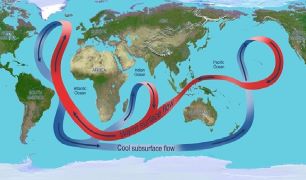
Concerns Rise Over Weakening of Atlantic
Meridional Overturning Circulation
Recent scientific studies have raised fresh concerns
regarding the weakening of the Atlantic Meridional Overturning Circulation
(AMOC). AMOC is one of the Earth’s most important ocean circulation systems and
plays a crucial role in regulating global climate, ocean temperatures, and
weather patterns.
What is AMOC?
¨
The Atlantic Meridional
Overturning Circulation (AMOC) is a large system of ocean currents in the
Atlantic Ocean. It carries warm surface water from tropical regions toward the
North Atlantic, while colder and denser water sinks and flows southward in
deeper ocean layers.AMOC is considered a key part of the global “ocean conveyor
belt.”
Importance of AMOC
¨
Helps maintain moderate
weather conditions in Europe and North America.
¨
Regulates the global
distribution of heat.
¨
Influences monsoon
systems, rainfall patterns, and marine ecosystems.
¨
Plays a major role in
carbon absorption and climate stability.
Key Findings
¨
According to recent
studies, the Atlantic Meridional Overturning Circulation (AMOC) may weaken by
as much as 59% by 2100, with potentially devastating consequences for climate
systems as far away as the Indian subcontinent.
¨
While past studies
estimated a 15% slowdown over the last 50 years, new research using real-time
ocean measurements projects a much sharper decline, potentially weakening the
currents by up to 59% by 2100.
¨
Scientific evidence also
indicates that continued greenhouse gas emissions and freshwater influx into
the North Atlantic from melting Greenland ice sheets could disrupt thermohaline
circulation.
¨
Experts warn that
crossing a critical “tipping point” could trigger abrupt and potentially
irreversible disruptions in global climate systems, including changes in
rainfall patterns, ocean circulation, and temperature distribution.
Reasons Behind the Weakening of AMOC
¨
Melting of the Greenland
Ice Sheet and Arctic Ice: Accelerated melting of Greenland’s ice sheet and
Arctic sea ice is releasing large volumes of freshwater into the North
Atlantic, reducing seawater salinity and weakening the sinking of dense cold
water that drives the AMOC.
¨
Ocean Warming Due to
Climate Change: Rising global temperatures are warming surface ocean waters,
reducing their density and disrupting the thermohaline circulation mechanism
responsible for maintaining the AMOC.
¨
Anthropogenic Greenhouse
Gas Emissions: Long-term greenhouse gas emissions have intensified planetary
warming and ocean heat imbalance, increasing the vulnerability of the AMOC to
destabilisation.
Possible Global Impacts of AMOC Weakening
¨
Disruption of Global
Climate Systems: A weakened AMOC could significantly alter atmospheric
circulation and global heat distribution, leading to abrupt and widespread
climatic changes.
¨
Cooling in Europe:
Despite global warming, parts of Western Europe could experience substantial
cooling and harsher winters due to reduced northward transport of warm ocean
water.
¨
Sea-Level Rise Along
North American Coast: AMOC slowdown could accelerate sea-level rise along the
eastern coast of North America by weakening ocean circulation patterns that
regulate regional sea levels.
¨
Changes in Rainfall
Patterns: Tropical rainfall systems, including African and Amazonian rainfall
belts, may shift or weaken, increasing the risks of droughts and ecological
stress.
Implications for India
¨ Impact on Indian Monsoon: AMOC weakening could disrupt monsoon circulation by altering tropical heat distribution and atmospheric pressure systems, potentially reducing monsoon rainfall over parts of India.
¨ Possible Intensification of El Niño Effects: Studies suggest that stronger or more frequent El Niño events associated with AMOC slowdown may further suppress monsoon rainfall and increase drought risks in India.


 scheme will continue until September 30, 2026.jpg)