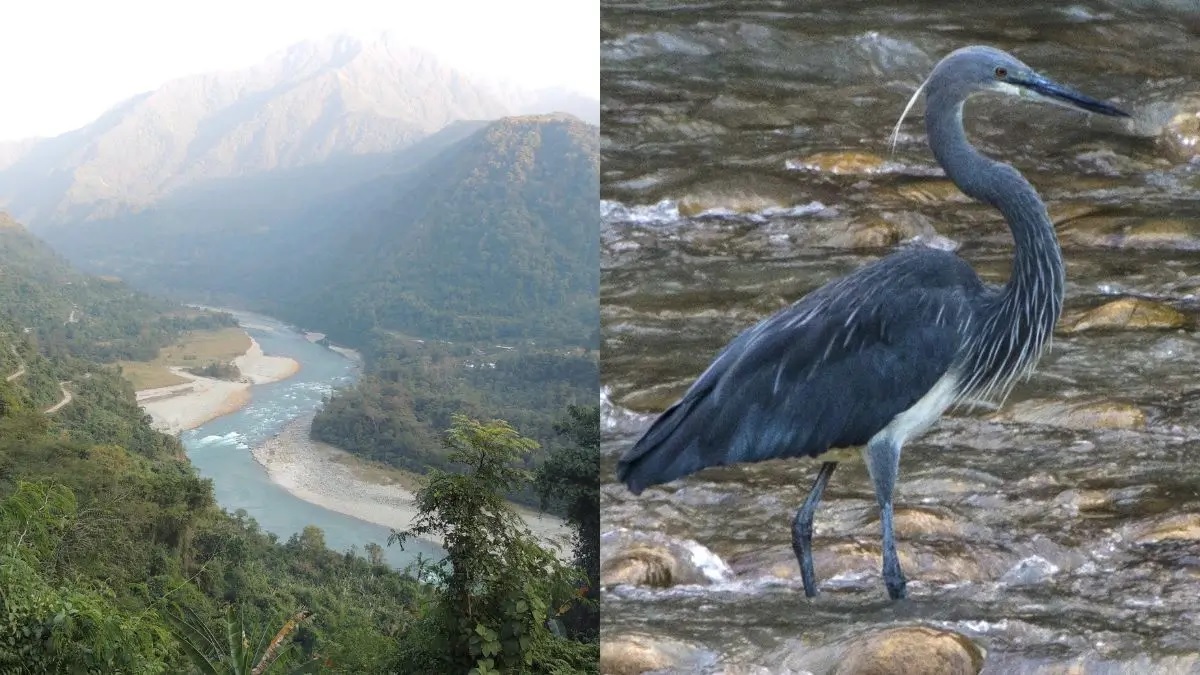
Union Environment Ministry expert committee has recommended environmental clearance for the 1,200-MW Kalai-II hydropower project on the Lohit River in Anjaw district of Arunachal Pradesh.Environmentalists have objected to the clearance, citing the omission of the critically endangered white-bellied heron from the project’s Environmental Impact Assessment (EIA) report.In 2020, the Expert Appraisal Committee (EAC) had itself required a detailed conservation plan for the heron while granting clearance to the 1,750-MW Lower Demwe project on the same Lohit River.The EIA for the Kalai-II project was prepared by WAPCOS Ltd, an accredited government EIA consultant.
Kalai-II Hydropower Project
¨
Project Location: The
project will be built by THDC India Ltd. in Hawai village, Anjaw district, on
the Lohit River.
¨ Design Components: The project involves constructing a 128.5-meter concrete gravity dam with pondage-based storage and an underground powerhouse.
About the White-Bellied Heron (Ardea insignis)
¨
Also known as the
imperial heron or great white-bellied heron.It is the second-largest living
species of heron.
¨
Habitat: Researchers
observed that the white-bellied heron prefers free-flowing riverine habitats
with minimal human disturbance.The species mainly feeds on fish found in river
rapids.
¨
Population Distribution:
It is found mainly on the southern side of the eastern Himalayas in the
landscape of central Bhutan, India, and Myanmar.In India, the white-bellied
heron occurs in Assam and Arunachal Pradesh.In Arunachal Pradesh, their
population is found in Lohit, Anjaw, and Changlang districts, including in
Kamlang and Namdapha tiger reserves.
¨
Nesting Sites: According
to Journal of South Asian Ornithology, Walong is the only nesting site in India
other than Namdapha Tiger Reserve.
¨ Threat: There is a sharp decline in population of the species due to habitat destruction, hunting, human interference, and risks like dams and power line collisions.Conservation Status
¨
Schedule-I species under
the Wildlife Protection Act, 1972
¨
IUCN Red List: Critically
Endangered
Environmental Impact Assessment (EIA)
¨
An EIA is a scientific
process to assess the likely environmental impacts of proposed projects such as
Mining, Dams, irrigation projects, industrial units, and waste treatment
facilities.
¨
The EIA framework also
mandates public consultation, including public hearings, enabling local
communities and stakeholders to examine and raise objections to the draft EIA
report prepared by experts.
¨
Under the Environment
(Protection) Act, 1986, India introduced the EIA Notification, 1994, later
replaced by the EIA Notification, 2006, which classifies projects into Category
A (central clearance) and Category B (state clearance, subdivided into B1 and
B2).
Steps Involved in the EIA Process
¨
Stage (1) – Screening:
Applicable only to Category ‘B’ projects, this stage determines whether an EIA
is required and accordingly classifies projects into B1 (EIA required) or B2
(EIA not required).
¨
Stage (2) – Scoping:
Identifies key environmental issues and impacts to be studied and finalises the
Terms of Reference (ToR) for preparation of the EIA report.
¨
Stage (3) – Public
Consultation: Seeks to ascertain and incorporate concerns of affected local
communities and other stakeholders through public hearings and written
responses.
¨
Stage (4) – Appraisal:
Involves detailed scrutiny by the Expert Appraisal Committee (EAC/SEAC)of the
Final EIA report, public consultation outcomes, and related documents to
recommend grant or rejection of environmental clearance.
 Bill, 2026.jpg)