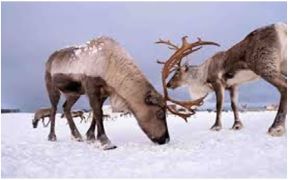
Declining Lichen Availability in the
Arctic Threatens Winter Survival of Caribou
A study by researchers at the State University of New
York College of Environmental Science and Forestry highlights that declining
lichen availability may threaten the winter survival of caribou in the Arctic.
Caribou (Reindeer)
¨
Caribou, scientifically
known as Rangifer tarandus, belong to the deer family (Cervidae).
¨ The terms “Caribou” (used
in North America) and “Reindeer” (used in Eurasia and for domesticated
populations) refer to the same species.
Key Biological Features:
¨
Both male and female
caribou grow antlers, which is a unique feature among deer species.
¨
Females typically give
birth to one calf each year under natural conditions.
¨
The newborn calf can
stand within minutes and begins walking within a day of birth.
¨
Caribou have large hooves
that help them walk on snow and also swim efficiently.
¨
Their hooves undergo
seasonal changes, becoming soft in summer for better grip and hard in winter
for ice traction.
¨
The hollow underside of
their hooves helps them dig through snow to reach food.
Diet and Ecological Role
¨
Lichens—often referred to
as "reindeer moss"—form the mainstay of the Caribou's winter diet.
¨
They are among the rare
animals capable of effectively digesting lichens.
¨ Caribou play a vital role
by regulating tundra vegetation and contributing to nutrient cycling within the
Arctic ecosystem.
Habitat and Distribution
¨ They are found in
Greenland, Scandinavia, Russia, Alaska, and Canada. They inhabit Arctic tundra
and boreal forest ecosystems.
Types: There are two types
¨
Tundra Caribou: These
live in large herds and are highly migratory.
¨
Woodland Caribou: These
inhabit forests and migrate relatively less.
Conservation Status
¨
IUCN Red List:
Vulnerable.
¨
Major Threats: Climate
change, habitat fragmentation, hunting, and predation by animals such as
wolves, bears, and lynx.
 Amendment Bill, 2026’ in Lok Sabha.jpg)