Increasing Likelihood of El Niño in Late
2026: Indication from Global Climate Models
Global climate models are pointing toward an
increasing probability of the emergence of El Niño conditions in the latter
half of 2026, marking a potential shift in the El Niño-Southern Oscillation
(ENSO) cycle. In its latest ‘El Niño-Southern Oscillation’ (ENSO) bulletin, the
National Oceanic and Atmospheric Administration (NOAA) has estimated that there
is an approximately 62% probability of El Niño emerging during June–August
2026, and it could persist through the end of 2026. The India Meteorological
Department (IMD) has also indicated that El Niño conditions could develop in
India after July this year; however, this will become clear only in the month
of April. The latest climate models indicate a greater than 50% probability of
El Niño developing in India after June—a likelihood that rises to approximately
70% during the months of July, August, and September. The timing of El Niño may
coincide with India's core monsoon months (June–September), during which
approximately 70% of the annual rainfall occurs. This could heighten the
vulnerability of rain-fed agriculture. Past cycles indicate that ENSO events
recur every 2 to 7 years. Historically, approximately 60% of El Niño years in
India have been associated with below-normal rainfall. The previous major El
Niño event (2023–24) was correlated with below-normal rainfall during the
Indian monsoon.
El Niño and La Niña
¨
The El Niño-Southern
Oscillation (ENSO) is a periodic climate phenomenon. It involves variations in
sea surface temperatures (SST) and atmospheric circulation within the
equatorial Pacific Ocean.
Normal Conditions
¨
Trade winds typically
blow from east to west along the equator.
¨
Under the influence of
these winds, warm surface water accumulates in the western part of the Pacific
Ocean (near Indonesia and Australia), while cold, nutrient-rich water upwells
near South America.
¨
Conversely, in the
eastern Pacific Ocean near South America (specifically off the coast of Peru),
the upwelling—the rising of cold, nutrient-rich water from the deep
ocean—continues.
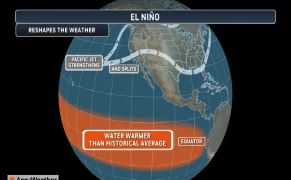
El Niño Phase (Warm Phase)
¨
Weakening or reversal of
trade winds.
¨
Shift of warm water
toward the east.
¨
Reduction in upwelling,
leading to disruptions in global atmospheric circulation.
It is defined as a condition in which the sea surface
temperature (SST) rises to at least 0.5°C above normal for a sustained period.
La Niña Phase (Cold Phase)
¨
Strengthening of trade
winds.
¨
Enhanced upwelling causes
sea surface temperatures in the eastern Pacific to become cooler than normal.
¨
Intensification of normal
circulation patterns.
Impacts of El Niño
Global
¨
Due to the release of
excess oceanic heat, El Niño years are often among the warmest years on record.
¨
This phenomenon alters
the Walker Circulation, leading to droughts in India, Australia, and Indonesia;
floods in the Americas; and the emergence of heatwave conditions globally.
¨
The Walker Circulation
(or Walker Cell) is a dominant east-west atmospheric circulation pattern found
in tropical regions. It is primarily driven by differences in surface
temperatures across the Pacific Ocean.
¨
During El Niño, the
process of upwelling (the rising of cold, nutrient-rich water from the depths
to the surface) is disrupted. Consequently, this has an adverse impact on fish
stocks and marine biodiversity, particularly in regions of the Pacific Ocean.
Impact on India
¨
El Niño is often
associated with below-normal Southwest Monsoon rainfall, which directly affects
*Kharif* crops such as rice and pulses.
¨ A reduction in rainfall
can lead to a decline in crop yields, an increased demand for irrigation, and
the emergence of rural distress.
¨ There is a likelihood of increased heatwave intensity, particularly in North and Central India.
¨ A decline in agricultural production can fuel food inflation, thereby impacting overall macroeconomic stability. Furthermore, a deficit in rainfall adversely affects reservoir levels, groundwater recharge, and the availability of drinking water.
 Bill, 2026.jpg)