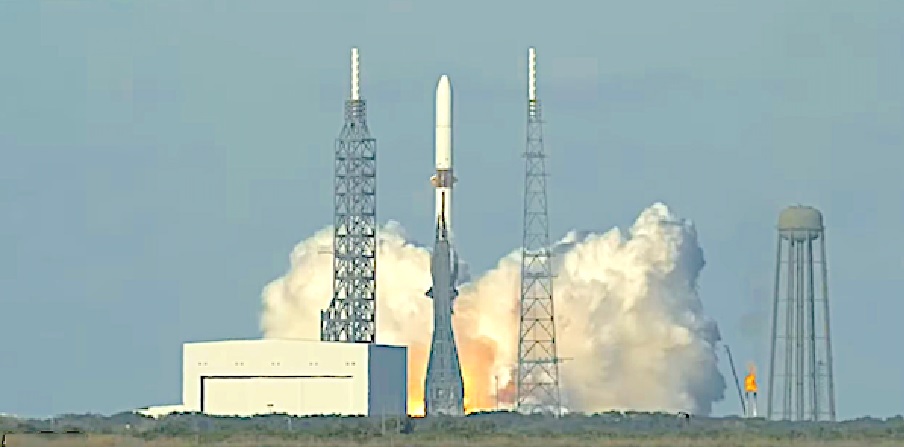
New Glenn orbital
launch vehicle successfully completed its second mission, deploying NASA’s
Escape and Plasma Acceleration and Dynamics Explorers (ESCAPADE)
twin-spacecraft into the designated loiter orbit.Blue Origin (American space
company) launched its New Glenn heavy-lift rocket from Cape Canaveral, carrying
NASA’s twin EscaPADE Mars spacecraft.The mission marked the rocket’s second
flight and its first operational mission for a paying customer.The mission
represents New Glenn’s first full success in both satellite deployment and
booster recovery.The booster recovery demonstrated Blue Origin’s reusable
launch capability for the first time.On its first flight in January 2025, New
Glenn reached orbit but did not succeed in landing the first stage on the
recovery platform.
Key Highlights of NASA’s Mission
¨
The EscaPADE spacecraft will travel for a year near Earth before using a
gravity assist to begin its journey to Mars in 2026.
¨ The two orbiters will reach Mars in 2027 and
begin an 11-month study of its upper atmosphere and magnetic interactions.
¨ The mission will investigate how the solar
wind interacts with the Martian environment and contributes to atmospheric
loss.
¨ The mission will also provide insights about
Martian space weather and help NASA better understand the conditions astronauts
will face when they reach Mars.
¨ The study aims to improve scientific
understanding of how Mars evolved from a wet planet to a dry one.
¨ The twin EscaPADE spacecraft will provide
synchronized observations of Mars for the first time.
¨
In addition, ESCAPADE will provide more information about Mars’
ionosphere — a part of the upper atmosphere that future astronauts will rely on
to send radio and navigation signals around the planet.
Significance of the Project
¨
Mars Exploration: ESCAPADE is one of the first missions to use dual,
synchronized orbiters to study interactions between a planet and the solar
wind, improving 3D modelling of Martian atmospheric loss.
¨ Support for Future Mars Missions: Data from
ESCAPADE will support mission design for MAVEN (Mars Atmosphere and Volatile
Evolution) follow-up missions and help refine long-term Mars habitability and
atmospheric evolution models.
¨ Enabling Human Exploration of Mars: The twin
Mars orbiters will generate crucial scientific insights that support future
human missions to Mars.
¨ UPSC Mains Practice QuestionThe New Glenn
NG-2 mission marks an important milestone in the evolution of commercial
heavy-lift launch systems. Discuss how such private-sector capabilities can
influence the future of interplanetary exploration, cost efficiency, and
strategic space partnerships.
¨
Strengthening Commercial Participation in Deep-Space Exploration: The
mission strengthens the role of commercial companies in NASA’s planetary and
lunar exploration programs.
 Bill, 2026.jpg)