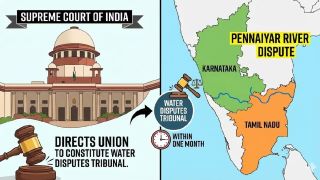
Pennaiyar River Water Dispute: Supreme
Court Directs Formation of Tribunal Within One Month
The Supreme Court has directed the central government
to constitute a tribunal within one month to resolve the long-standing dispute
between Tamil Nadu and Karnataka over the sharing of Pennaiyar river water.The
court stated that an institutional mechanism is necessary for the expeditious
settlement of inter-state river water disputes to protect the interests of
farmers and the general public in both states. The proposed tribunal will
examine water allocation, usage, and related grievances and suggest solutions.
Background of the Dispute
¨
Tamil Nadu filed an
original suit in 2018 under Article 131 of the Constitution, invoking the
Supreme Court’s original jurisdiction in disputes between States and the Union.
¨
The dispute relates to
dams and diversion structures constructed by Karnataka on the Pennaiyar and its
tributary Markandeya River.
¨
Tamil Nadu argued that
while the flow of water of an inter-State river is a national asset and no
single state can claim exclusive ownership of its water, Karnataka’s projects
adversely affect downstream water availability and violate existing agreements.
¨
Karnataka is the upper
riparian State while Tamil Nadu is the lower riparian State in the Pennaiyar
river basin.
Negotiations and Mediation Efforts
¨
The Union Government
initially explored the possibility of resolving the dispute through
negotiations between the States.
¨
In January 2024, the
Supreme Court directed the constitution of a negotiation committee under the
Inter-State River Water Disputes Act 1956.
¨
The Court noted that the
Act allows tribunal formation only after failure of negotiations within one
year.
¨
In November 2024, the
Court was informed that mediation between the States had failed, necessitating
recourse to the tribunal mechanism.
River Water Disputes Tribunals
¨
The Inter-State River
Water Disputes (ISWD) Act, 1956, is the primary legislation enacted by
Parliament under Article 262 of the Constitution to resolve disputes between
states over waters of inter-state rivers or river valleys.
¨
Under the Act, the Union
Government has constituted multiple ad-hoc inter-State river water dispute
tribunals over the years to adjudicate specific disputes between States.
¨
The awards of inter-State
river water dispute tribunals are final and binding on the parties.
¨
Under Article 262(2) of
the Constitution and Section 11 of the ISWD Act, 1956, the jurisdiction of the
Supreme Court and High Courts is expressly barred in respect of water disputes
referred to a tribunal.
¨
While the proposal for a
permanent tribunal was a central feature of the Inter-State River Water
Disputes (Amendment) Bill, 2019, the bill officially lapsed upon the
dissolution of the 17th Lok Sabha in 2024.
¨
Current Framework: As the
amendment did not become law, the Inter-State River Water Disputes Act, 1956, remains
in effect. This means the government must still set up ad-hoc (temporary)
tribunals for each specific dispute rather than using one permanent body.
Pennaiyar River
¨
The Pennaiyar River, also
known as the South Pennar, Ponnaiyar or Dakshina Pinakini, is a 576 km
east-flowing Peninsular river, flowing through Karnataka and Tamil Nadu.
¨
It is the second-largest
interstate east-flowing river basin located between the Pennar and Cauvery
basins.
¨
Major tributaries include
Markandeya, Pambai, and Chinnar.
¨
Origin: It rises at an
elevation of about 900 metres in the Nandi Hills of the Chikkaballapura
district in Karnataka.
¨ Path: From its source, it flows southward for about 80 km in Karnataka before entering Tamil Nadu near Hosur. It then travels southeast for another 320–420 km, eventually emptying into the Bay of Bengal near Cuddalore.
¨ Basin Distribution: The total drainage area is approximately 16,019 sq. km. Tamil Nadu holds about 77% of this basin, with the remainder in Karnataka (~22%) and a tiny portion in Andhra Pradesh.
.jpg)