Shiva Nataraja to Somaskanda: US museum to
return three illegally taken bronze sculptures to India
Smithsonian’s National Museum of Asian Art, United
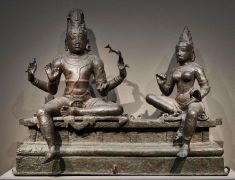
States, has decided to return the sculptures of Nataraja, Somaskanda, and Saint
Sundarar with Paravai to the Government of India after confirming that they
were illegally removed from temple settings in Tamil Nadu.
More on the News
¨
The decision is regarded
as a major milestone in the international recovery of India’s stolen cultural
heritage.
¨
It also serves as a
validation of the Mutual Legal Assistance Treaty (MLAT)-based recovery strategy
pursued by the Tamil Nadu Idol Wing–CID.
¨
Relevant documents and
MLAT- related materials were submitted to the museum in 2022.
¨
In 2023, the French
Institute of Pondicherry’s photo archives established that the sculptures had
been photographed in functioning temples between 1956 and 1959.
¨
These findings were
subsequently reviewed and affirmed by the Archaeological Survey of India, which
confirmed that the removals violated Indian law.
Key Features of sculptures
|
Name of
Sculpture |
Period / Date |
Location |
Main Features |
|
Nataraja |
Chola period (10th century); photographed in 1957 |
Shri Bhava Aushadheshwar Temple, Thanjavur district, Tamil Nadu |
Shiva is shown performing the cosmic dance within a circle of flames;
represents the five cosmic acts (Panchakriya) — creation (damaru),
preservation (abhaya mudra), destruction (fire), concealment (foot placed on
the ground), and liberation (raised foot). |
|
Somaskanda |
12th century;
photographed in 1959 |
Vishwanath
Temple, Alattur village, Tamil Nadu |
Four-armed
Shiva holding a battle-axe and deer in upper hands, citron in lower left
hand, and abhaya mudra in lower right; Parvati holds a blue lotus; the
pedestal has four rings for ceremonial procession. |
|
Saint Sundarar and Paravai |
Vijayanagara period (16th century); photographed in 1956 |
Shiva Temple, Veerasolapuram village, Tamil Nadu |
Depicts the Shaiva saint Sundarar and his wife Paravai; highlights
Paravai’s devotion to both Shiva and her husband. |
Mutual Legal Assistance Treaties (MLATs)
¨
MLA is a formal mechanism
that enables countries to cooperate in criminal investigations and
prosecutions, especially when evidence or proceeds of crime are located abroad.
¨
Such cooperation is
generally governed by bilateral treaties or agreements between countries.
¨
MLATs are increasingly
used in cases involving heritage crimes, financial offences, and transnational
investigations.

.jpg)