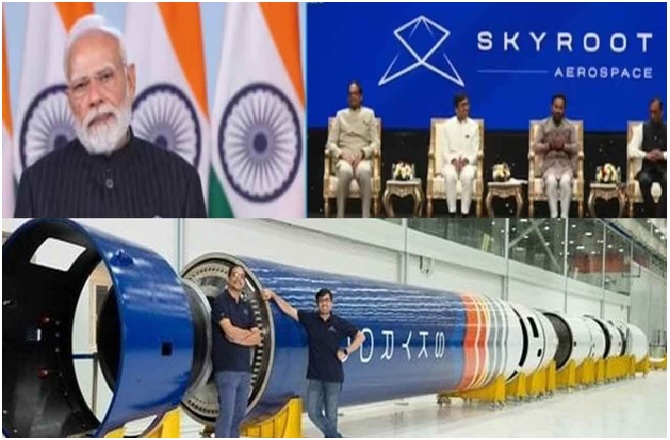
Prime Minister of India inaugurated Skyroot’s Infinity
Campus in Hyderabad, Telangana. The Prime Minister also unveiled Skyroot’s
first orbital rocket, Vikram-I, with the capability to launch satellites to
orbit. He underscored that India’s Space reforms—opening the space sector for
private players, establishing IN-SPACe, and enabling startup participation—are
transforming the country into a major global space launch hubHe highlighted
government efforts to strengthen research through the National Research
Foundation, One Nation One Subscription, and the ₹1 lakh crore Research,
Development and Innovation Fund. The Prime Minister reaffirmed that India aims
to scale its launch capacity and create five new space-sector unicorns in the
next five years.
Skyroot’s Infinity Campus
¨
The Infinity Campus was
inaugurated as a state-of-the-art facility designed to support end-to-end
development of launch vehicles.
¨
The facility represents
the growing capability of private space companies in India and reflects the
country’s shift toward an open and innovation-led space ecosystem.
¨
The campus is expected to
accelerate design, integration, testing, and manufacturing processes for
orbital rockets, strengthening India’s private launch infrastructure.
Vikram-I Rocket
¨
Vikram-I, Skyroot’s first
orbital rocket represents a major milestone in India’s private spaceflight
capability, following the success of Skyroot’s earlier sub-orbital mission.
¨
Vikram-I is designed for
launching small satellites, addressing growing global demand and increasing
launch frequencies across the world.
¨
The Vikram-I rocket is
the first in the Vikram series and consists of three solid-fuel stages, each
with a burn time of about 80 to 100 seconds.
¨
The fourth and final
stage uses the Raman engine, which operates on Monomethylhydrazine (MMH) and
Nitrogen Tetroxide (NTO) liquid propellants in a cluster of four engines.
¨
The Raman engine cluster
produces a total thrust of 3.4 kN and is used for precise orbital adjustments
during the final phase of the mission.
¨
The rocket is designed to
place a 290 kg payload into a 500 km Sun Synchronous Polar Orbit.
¨
It can also lift a 480 kg
payload to a 45° inclined Low Earth Orbit at 500 km altitude.
¨
The launch of Vikram-II
is scheduled for 2026.
 Bill, 2026.jpg)