Scientists working in Antarctica
discovered the oldest directly dated ice and air sample ever found on Earth
¨
Scientists working in
Antarctica discovered the oldest directly dated ice and air sample ever found
on Earth.
¨
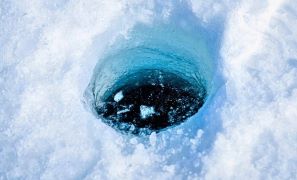
The sample was recovered
from the Allan Hills region of East Antarctica.
¨
It contains tiny air
bubbles trapped inside ice that is around 6 million years old.
¨
Scientists determined the
age of the samples through argon isotope analysis.
¨
The Allan Hills region is
known for its ancient blue ice layers.
¨
Air trapped inside the
ice provides direct evidence of Earth’s ancient atmosphere.
¨
This differs from many
other climate records that rely on indirect indicators.
¨
The study indicated that
Antarctica experienced around 12°C of long-term cooling over the past 6 million
years.
¨
The discovery was made by
scientists associated with the National Science Foundation-supported Center for
Oldest Ice Exploration (COLDEX).
¨
The research was led by
Sarah Shackleton and John Higgins.
¨
The findings were
published in October 2025 in the journal “Proceedings of the National Academy
of Sciences.”
¨
Researchers used argon
isotopes trapped in air bubbles to determine the age of the ice.
¨
The European “Beyond
EPICA – Oldest Ice” project completed its final Antarctic expedition in May
2026.
¨
Under the project, a
2.8-kilometre-long ice core was extracted from the Little Dome C region of East
Antarctica.
¨
The ice core is estimated
to be about 1.2 million years old.
¨
It contains greenhouse
gas bubbles such as carbon dioxide and methane.
¨
The “Beyond EPICA –
Oldest Ice” project involves 14 laboratories from 10 European countries.
¨
Ice cores are considered
important for studying Earth’s ancient climate and atmosphere.
¨
Scientists use these
samples to understand how Earth’s climate changed over millions of years.
¨ The study is expected to improve understanding of the Mid-Pleistocene Transition.
¨ The Mid-Pleistocene Transition was a period when the pace and pattern of Earth’s ice-age cycles changed significantly.