The Arctic Report Card 2025 reveals unprecedented
warming and widespread ecological changes in the Arctic region. The report
clearly demonstrates that the pace of climate change has accelerated
significantly and its impacts are no longer confined to the polar regions, but
are profoundly affecting the global environmental balance and socio-economic
structures.
According to the report, the rate of temperature
increase in the Arctic is several times higher than the global average. Rising
temperatures are leading to rapid melting of sea ice, shrinking glaciers, and
permafrost degradation. These changes not only increase the risk of sea-level
rise but are also causing instability in global weather patterns.
More on the News
¨
The Arctic Report Card
2025 is the 20th annual edition, published by the National Oceanic and
Atmospheric Administration (NOAA) with contributions from international
scientists and Indigenous partners.
¨
The report provides a
peer-reviewed assessment of atmospheric, oceanic, cryospheric and terrestrial
changes in the Arctic region.
¨
It documents conditions
observed mainly between October 2024 to September 2025.
Key Findings of the Arctic Report Card
2025
Arctic Climate
¨
The Arctic recorded its
warmest surface air temperatures since 1900 during October 2024 to September
2025.
¨
The last ten years have
been the ten warmest on record in the Arctic.
¨
Arctic temperatures have
risen at more than twice the global average rate since 2006.
¨
Precipitation levels
during the year reached a new historical high.
Arctic Ocean and Sea Ice
¨
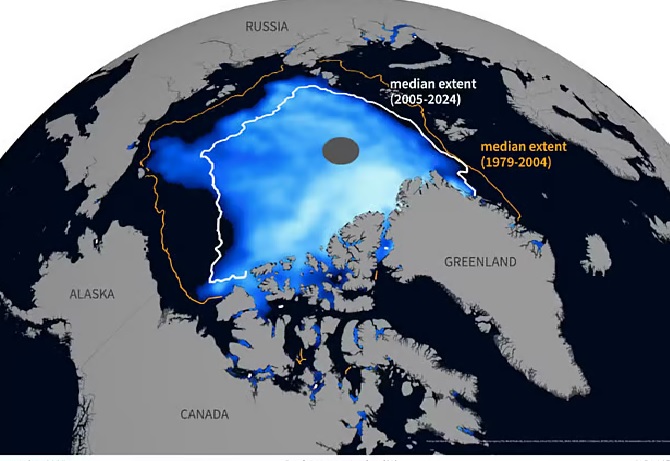
Winter sea ice extent in
March 2025 was the lowest in the 47-year satellite record.
¨
September 2025 marked the
tenth lowest minimum sea ice extent on record.
¨
The oldest and thickest multi-year
sea ice has declined by over 95 percent since the 1980s.
¨
Atlantification has
reached the central Arctic Ocean, weakening ocean stratification and
accelerating ice melt.
¨
Atlantification refers to
the increasing influence of warm, salty Atlantic Ocean waters in the Arctic
Ocean, leading to physical, chemical, and biological changes in the Arctic
marine system.
Marine Ecosystems
¨
Phytoplankton
productivity increased sharply across most Arctic regions between 2003 and
2025.
¨
Warming seas and reduced
ice cover are reshaping fish distribution and Arctic fisheries, affecting food
security and Indigenous subsistence practices.
¨
Warmer conditions are
driving northward expansion of boreal species into Arctic waters and
landscapes, altering food webs and traditional ecological balances.
Cryosphere and Glaciers
¨
Arctic glaciers in
Scandinavia and Svalbard recorded their highest annual ice loss between 2023
and 2024.
¨
The Greenland Ice Sheet
lost about 129 billion tonnes of ice in 2025.
¨
Long-term glacier loss is
contributing to global sea level rise and increasing disaster risks.
Land Systems and Permafrost
¨
Iron and other mineral
mobilization from thawing permafrost has turned waters orange in over 200
Arctic Alaska watersheds called “Rusting Rivers,” degrading water quality,
habitat, and traditional water supplies.
¨
Thawing permafrost refers
to the melting of permanently frozen ground that has remained at or below 0 °C
for at least two consecutive years, mainly found in Arctic and sub-Arctic
regions.
¨
Degraded water quality is
threatening aquatic ecosystems and rural drinking water supplies.
¨
Arctic tundra greenness
in 2025 was the third highest in the satellite record.
¨
Arctic tundra greenness
(subset of the “Greening of the Arctic”) refers to the observed increase in vegetation
growth and plant productivity in Arctic tundra regions due to rising
temperatures and longer growing seasons.
Indigenous Knowledge and Partnerships
¨
Indigenous-led
observation networks continue to play a critical role in monitoring
environmental change.
¨
Community-based
initiatives are improving food safety and environmental awareness.
¨
Long-standing
partnerships enhance scientific understanding and adaptive capacity in the
Arctic.
Significance of the Report
¨
Bellwether of Climate
Change: The report underscores the Arctic as a frontline indicator of global
climate change.
¨
Mitigation Need: It
highlights the urgency of climate mitigation due to cascading global impacts.
¨
Role of Indigenous
Communities: It reinforces the importance of local communities and their
Indigenous knowledge in climate science.
¨
Global Environmental
Architecture: It informs the need to strengthen International climate policy
and environmental governance efforts.


 scheme will continue until September 30, 2026.jpg)