Historic trade agreement between Trump and
Modi
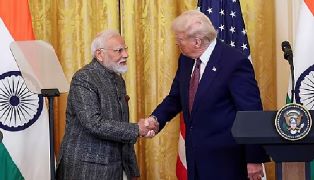
American President Donald Trump said on February 2,
2026 that he and Prime Minister Narendra Modi have “agreed to a trade deal”
between the United States and India, under which the United States will impose
lower reciprocal tariffs, reducing them from 25% to 18%.In a post on his social
media handle Truth Social, Trump mentioned his conversation earlier in the day
with Prime Minister Narendra Modi.Trump said that PM Modi is one of his best
friends and a powerful and respected leader of his country. Trump also said
that PM Modi and he are two people who get things done.
He claimed that the Prime Minister agreed to “stop
buying Russian oil” and potentially buy much more oil from Venezuela.During the
same conversation, Trump also indicated that India would source Venezuelan oil
instead of Iranian supplies. However, India had already stopped importing
Iranian crude oil in 2019.The Government of India has not yet made any
announcement regarding the trade deal with the United States.This agreement
comes after several months of negotiations, during which the Donald Trump
administration had imposed a heavy 50% tariff on Indian exports to the U.S.
Trump has said that India has promised to buy $500 billion worth of energy,
tech, agriculture, and coal from the U.S.This deal comes a few days after India
and the EU announced a trade deal that both sides described as the ‘mother of
all deals’. While the European Union, as an economic bloc, is India’s largest
trading partner, the U.S. remains the single largest trading partner.
India–US economic relations
¨
With changes in India’s
economic policy in the 1990s, there was a broad improvement in India–US
economic relations.
¨
For the past two decades,
the U.S. has been an important trading partner for India in goods and services
trade. In 2018, a record trade of USD 142.6 billion took place between the two
countries.
¨
Based on 2025 data, the
United States has emerged as a top-three investor in India; for example, during
April–June 2025, a record USD 5.61 billion was invested through FDI inflows.
¨
While historically
Singapore and Mauritius were ahead in total investment, the U.S. has
significantly increased its share to secure third place (USD 77.27 billion
between April 2000 and September 2025).
Trade disputes
¨
The U.S. has long
criticized India’s high tariffs on agricultural and industrial products, while
India has objected to non-tariff barriers on pharmaceuticals and IT services.
¨
In 2018, when the U.S.
imposed duties on steel and aluminum, India retaliated by increasing duties on
29 American products.
¨
The U.S. goods trade
deficit with India increased by 5.4% in 2024 to USD 45.7 billion, becoming a
growing concern for Washington regarding trade imbalance.
¨
Visa and immigration restrictions
for Indian professionals: Despite strong educational and business ties, visa
restrictions and work permit issues continue to create friction.
¨
The H-1B visa program,
which is important for India’s IT sector, is facing quotas, delays, and
restrictions on extensions.
¨
Demand for U.S. green
cards among Indians remains high, yet progress is slow due to the number of
pending applications and strict annual caps.
India–US defense cooperation agreements
¨
The foundation of
India–US defense cooperation was laid with the General Security of Military
Information Agreement (GSOMIA) in 2002.
¨
In 2016, the Logistics
Exchange Memorandum of Agreement (LEMOA) was signed.
¨
In 2018, the
Communications Compatibility and Security Agreement (COMCASA) enhanced access
to secure military communications and advanced defense technologies.
¨
In 2020, the Basic
Exchange and Cooperation Agreement (BECA) enabled the sharing of critical
geospatial data for military operations.
¨
Joint exercises and the
2+2 ministerial dialogue were promoted.
¨
India was designated as a
Major Defense Partner in 2016 and was granted Strategic Trade Authorization
Tier 1 status in 2018.
¨
The Defense Trade and
Technology Initiative (DTTI), established in 2012, streamlined defense trade
and promoted co-production and co-development of defense technologies.
¨ INDUS-X: The launch of the India–US Defense Acceleration Ecosystem (INDUS-X) in June 2023 promoted defense innovation and industrial cooperation.
¨ I2U2 includes India, Israel, the United States, and the United Arab Emirates, and is dedicated to joint investments and new initiatives across various sectors including water, energy, transportation, space, health, and food security.
.jpg)