Indian Space Research
Organisation successfully completed the second Integrated Air Drop Test under
the Gaganyaan mission from the Satish Dhawan Space Centre
The Indian Space Research
Organisation (ISRO) recently successfully completed the second Integrated Air
Drop Test under the Gaganyaan mission from the Satish Dhawan Space Centre. This
achievement marks a significant step towards India's human spaceflight mission
and also demonstrates the development of advanced technology within the
country. The Gaganyaan mission is India's first human spaceflight program,
aimed at safely sending Indian astronauts into space and bringing them back to
Earth. In the tests being conducted under this mission, safety and reliability
are being accorded the highest priority. The IADT-02
test was specifically conducted to validate the Crew Module's safe landing
system, which ensures the safety of astronauts during emergency situations.
Integrated Air Drop
Test
¨ A
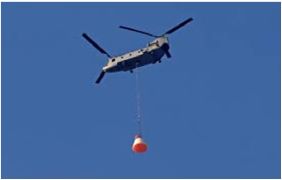
simulated Crew Module (~5.7 tons, equivalent to Gaganyaan G1) was
carried to an altitude of approximately 3 km by an Indian Air
Force Chinook helicopter and released into a designated maritime 'drop zone'
near the Sriharikota coast.
¨
During
the landing sequence, 10 parachutes of 4 different types were
deployed in a precise sequence.
¨ These
parachutes ensured a gradual reduction in the module's velocity to facilitate a
safe touchdown.
¨ The
module was successfully recovered with the assistance of the Indian Navy. IADT-02 has
validated the parachute-based deceleration system.
¨ This
test is crucial for ensuring the safe recovery of the Crew Module, as this is
the very module that brings the astronauts back during a human spaceflight
mission.
¨
The
first test was conducted on August 24, 2025, at the Satish Dhawan Space Centre.
¨
During
that instance, a 4.8-ton dummy Crew Module was dropped from an altitude of 3 km
using a helicopter. Gaganyaan Mission
¨
The
objective of the Gaganyaan mission is to demonstrate human spaceflight
capability by launching a three-member crew into a 400 km
orbit for a three-day mission, and safely returning them to Earth via a
splashdown in Indian territorial waters.
The development of
several critical technologies is essential for the success of the mission,
including:
A Human-Rated Launch Vehicle for
the safe transport of astronauts.
¨
Life
Support Systems to provide an Earth-like environment in space.
¨
A
Crew Emergency Escape System to rescue the crew in the event of an emergency.
¨ Crew
management, which encompasses the training of astronauts, as well as their safe
recovery and rehabilitation post-mission.

 Programme.jpg)