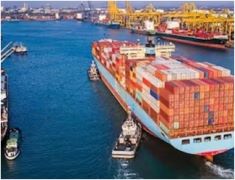
Amidst West Asia Conflict, Singapore
Emerges as India's Second-Largest Export Destination
The impact of the prolonged conflict in West Asia is
now becoming clearly visible on global trade and energy supply chains. India,
too, has been affected by this geopolitical crisis; specifically, it has had a
significant impact on its trade routes and energy import arrangements. Amidst
rising tensions in the Gulf region and disruptions to maritime trade routes, a
major shift has been observed in India's export landscape. In this context,
Singapore has surpassed the United Arab Emirates (UAE) to secure the position
of India's second-largest export destination, while the United States continues
to remain India's largest export market.
Key Highlights
¨
Geopolitical Disruptions
to Trade: The blockade of the Strait of Hormuz (a critical maritime choke point
situated between Iran and Oman) has compelled Indian traders to seek
alternative logistics routes, thereby severely disrupting traditional trade
with the West Asian region. Previously, this strait accounted for one-fifth of
global oil flows.
¨
Surge in Exports to
Singapore: Capitalizing on its status as a transit hub and leveraging its Free
Trade Agreement (FTA) with India, exports to Singapore witnessed a remarkable
surge of 180%. In contrast, exports to the UAE (another key FTA partner)
experienced a decline of 36%.
¨
Diversification of Energy
Imports: As traditional Middle Eastern supplies face restrictions, India has
diversified its crude oil sourcing, bringing countries such as Oman, Peru, and
Nigeria into its list of top 20 import sources. Broad Macroeconomic Pressure on
India: The global energy supply crisis has inflated India's import bill and
severely impacted its currency, causing the Indian Rupee to slide to several
record lows (depreciating by 5.2% against the US Dollar since February 2026).
To manage foreign exchange reserves and curb fuel consumption, the government
has raised import duties on precious metals and allowed oil marketing companies
to hike retail petrol and diesel prices for the first time in four years.
India-Singapore Trade and Economic
Cooperation
¨
Trade Dynamics: Driven by
the Comprehensive Economic Cooperation Agreement (CECA), bilateral trade surged
from US$ 6.7 billion in FY 2004-05 to US$ 34.3 billion in FY 2024-25, making
Singapore India's sixth-largest trading partner.Singapore is the largest source
of Foreign Direct Investment (FDI) into India (US$ 14.94 billion in FY
2024-25).
¨
Institutional Frameworks:
To actively facilitate cross-border capital flows, Invest India opened a
dedicated office in Singapore in September 2024—a move complemented by the
Singapore Business Federation establishing its first Indian office in Bengaluru
in November 2025.
¨ Pioneering Fintech Integration: The bilateral financial infrastructure—facilitated through the UPI-PayNow linkage—has set a global benchmark by establishing India's first operational cross-border Person-to-Person (P2P) payment facility.
¨ Digital Commerce and Trade Finance: Strategic collaborations include ONDC-Proxtera connectivity for international retail applications, the GIFT Connect linkage (integrating liquidity pools between the NSE and SGX for NIFTY products), and the TradeTrust architecture, which enables interoperable electronic Bills of Lading (eBL).
.jpg)