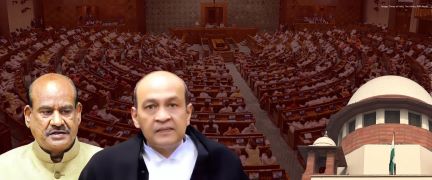
Inquiry Committee Submits Report on
Allegations Against Former High Court Judge Yashwant Varma
An inquiry committee constituted under the Judges
(Inquiry) Act, 1968 has submitted its report to the Speaker of the Lok Sabha
regarding allegations of unaccounted cash recovery against former High Court
judge Yashwant Varma. The matter is considered significant in the context of
judicial transparency, accountability, and constitutional procedures in
India.The Judges (Inquiry) Act, 1968 lays down the procedure for investigating
allegations against judges of the High Courts and the Supreme Court. Under this
law, an inquiry committee can be constituted through Parliament when serious
allegations are made against a judge. The committee examines the charges and
submits its findings to the concerned constitutional authority.
More on the News
¨
The three-member inquiry
committee constituted by Speaker Om Birla on August 12, 2025, submitted its
report on May 18, 2026, and it will be tabled before both Houses of Parliament
in due course.
¨
The case originated after
burnt currency notes were allegedly discovered during a fire at Justice Varma’s
official Delhi residence in Delhi on March 14, 2025, following which an
in-house committee constituted by former Chief Justice of India Sanjiv Khanna
reportedly found prima facie evidence indicating his “active or tacit control”
over the storeroom where the cash was found.
¨
Justice Varma resigned
from the Allahabad High Court in April 2026, effectively rendering the
impeachment proceedings infructuous, though the inquiry committee continued and
completed its investigation.
Removal of Judges
¨
Judges (Inquiry) Act,
1968: Enacted under Article 124(5), the Act regulates the procedure for the
investigation and removal of judges.A removal motion may originate in either
House of Parliament and must be signed by at least 100 Lok Sabha members, or at
least 50 Rajya Sabha members.The Speaker or Chairman may admit or reject the
motion after consultation.
If admitted, a three-member inquiry
committee is constituted comprising:
¨
A Supreme Court judge,
¨
A Chief Justice of a High
Court, and
¨
A distinguished jurist.
If the committee finds the judge guilty of
misbehaviour or incapacity, Parliament may proceed with the removal process
under Article 124(4).
Article 124(4) of the Constitution
¨
A Supreme Court judge can
be removed by Parliament on grounds of “proved misbehaviour” or “incapacity”.
¨
The removal motion must
be passed by both Houses in the same session by a majority of the total
membership of the House, and a two-thirds majority of members present and
voting.
¨
After Parliament passes
the motion, the President issues the order for the removal of the judge.
In-House Procedure
¨
The in-house mechanism
was evolved by the Supreme Court in the C. Ravichandran Iyer v. Justice A.M.
Bhattacharjee Case (1995).
¨
The Supreme Court
distinguished between “bad behaviour” and “impeachable misbehaviour”, reserving
impeachment for serious misconduct.
¨
Under this procedure, the
Chief Justice of India may constitute a three-member committee to examine
allegations against judges of the Supreme Court or High Courts.
¨
If serious misconduct is
found, the CJI may advise the judge to resign or retire voluntarily.
¨
If the judge refuses, the
CJI may direct that no judicial work be assigned to the judge and inform the
President and Prime Minister to initiate removal proceedings.
Prevention of Corruption Act (PCA), 1988
¨
In the K. Veeraswami v.
Union of India Case (1991), the Supreme Court held that Supreme Court and High
Court judges are “public servants” under the Prevention of Corruption Act.
¨ FIRs against sitting judges can be registered only after obtaining prior approval from the Chief Justice of India.
¨ Since judges do not have a conventional employer-employee relationship with the President, sanction for prosecution is provided by the CJI or by another senior Supreme Court judge in cases involving the CJI.
.jpg)