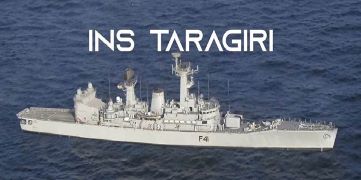
Indian Navy commissioned INS Taragiri in
Visakhapatnam
Indian Navy commissioned INS Taragiri at
Visakhapatnam, marking a major step in enhancing India’s maritime power,
self-reliance, and Indo-Pacific security presence.
INS Taragiri
¨
INS Taragiri is the
fourth Nilgiri-class (Project 17A) stealth guided-missile frigate.
¨
It is part of a 7-ship
Project 17A programme, with 4 built by Mazagon Dock Shipbuilders Limited and 3
by GRSE.
¨
It is designated as F41
and inducted into the Eastern Fleet under the Eastern Naval Command.
¨
It is named after the
Taragiri hills in Uttarakhand.
¨
It carries forward the
legacy of the Leander-class INS Taragiri (1980–2013).
¨
Its motto is “Rise
Above.”
Construction & Indigenous Ecosystem
¨
The ship has a
displacement of approximately 6,670 tonnes.
¨
It was built in about 15%
less time compared to earlier ships.
¨
It has more than 75%
indigenous content with contributions from over 200 MSMEs.
¨
It reflects a strong
public-private partnership and supports thousands of jobs.
Design & Advanced Technology
¨
It represents a
generational upgrade over Shivalik-class frigates.
¨
It incorporates stealth
features with reduced radar, acoustic, and infrared signatures.
¨
It is powered by a CODOG
(Combined Diesel or Gas) propulsion system.
¨
It can achieve high
speeds of around 30 knots along with long endurance.
¨
It is equipped with a
Combat Management System (CMS) for real-time threat response.
¨
It includes an Integrated
Platform Management System (IPMS) for centralised control of machinery and
power.
Combat Capabilities
¨
It is equipped with
BrahMos supersonic missiles for surface strike capability.
¨
It uses the MRSAM/Barak
system along with MF-STAR radar for air defence.
¨
It is fitted with HUMSA
sonar for anti-submarine warfare.
¨
It carries torpedoes and
ERASR (Extended Range Anti-Submarine Rocket).
¨
It includes a 76 mm SRGM
and close-in weapon systems (30 mm and 12.7 mm guns).
¨
It is capable of
addressing threats across air, surface, and sub-surface domains.
Operational Role & Versatility
¨
It can perform carrier
battle group escort missions.
¨
It is capable of
undertaking independent offensive operations.
¨
It supports maritime
surveillance and anti-piracy missions.
¨
It can conduct coastal
security operations.
¨
It is suitable for
Humanitarian Assistance and Disaster Relief (HADR) operations.
¨
It can operate
helicopters such as Kamov and MH-60R.
¨
It can remain deployed at
sea for extended durations.
Unique Features & Utility
¨
It generates
approximately 4 MW of power, enough to support around 8,000 homes during
disasters.
¨
Its indigenous systems
enable faster maintenance and reduced downtime.
¨
It is operated by around
300 personnel, including provision for women officers and sailors.
Significance
¨
Maritime Security
Imperative: With a ~11,000 km coastline and ~95% of trade via sea, it ensures
protection of sea lanes, choke points, energy routes, and undersea
communication cables, thereby safeguarding India’s economic and digital
infrastructure.
¨
Strengthening Naval
Capability: As a stealth, multi-role warship with advanced sensors, supersonic
missiles, and long endurance, it enhances operational reach, combat readiness,
surveillance, and rapid response while strengthening presence from the Persian
Gulf to the Malacca Strait.
¨
Aatmanirbhar Bharat in
Defence: With over 75% indigenous content and participation of 200+ MSMEs, it
reduces import dependence, strengthens the defence industrial ecosystem,
reflects strong public-private partnership, and aligns with rising defence
exports (~₹38,000+ crore).
¨
Strategic &
Geopolitical Significance: Equipped for multi-domain warfare and deployed in
the Eastern Fleet, it acts as a credible deterrent in Indo-Pacific geopolitics,
supports India as a net security provider, remains relevant amid tensions like
Strait of Hormuz disruptions, and complements naval modernisation including INS
Aridhaman.
¨
Multi-Dimensional Role:
Beyond combat, it enables carrier escort operations, anti-piracy missions,
maritime surveillance, coastal security, disaster relief, evacuation missions,
and humanitarian assistance, including power support during crises.
¨
Symbol of Maritime Power
& Sovereignty: It represents Make in India, technological maturity, faster
shipbuilding capability, and India’s transition to a self-reliant blue-water
navy, reinforcing the vision of Viksit Bharat 2047 and a secure Indo-Pacific.
 Bill, 2026.jpg)