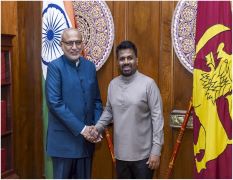
Vice
President of India's Visit to Sri Lanka
- India has recently expanded the scope of the Overseas
Citizen of India (OCI) scheme in Sri Lanka by extending eligibility from the
fourth generation to the sixth generation of persons of Indian origin.The
announcement was made during the official visit of Vice-President C P
Radhakrishnan to Sri Lanka, reflecting India’s renewed engagement with its
diaspora in the region.The move primarily benefits the Indian-origin Tamil
(Malaiyaha Tamil) community, whose ancestors migrated during the colonial
plantation period.It represents a significant shift in India’s diaspora policy,
aligning with its broader neighbourhood outreach and regional diplomacy
objectives.
Key Highlights of the Expansion
- The eligibility for OCI
cards has been extended to the fifth and sixth generations, compared to the
earlier limit of the fourth generation.
- To ease procedural
challenges, documents issued by the Sri Lankan government will now be accepted
as proof of ancestry.
- Removes barriers for
younger descendants lacking old Indian records, benefiting an estimated 300,000
people in hill-country plantations.
Significance of Expansion
- Strengthening
People-to-People Ties: The extension reconnects multiple generations of
Indian-origin Tamils with their ancestral roots, deepening cultural and social
linkages.
- Boost to Neighbourhood
First Policy: It reflects India’s commitment to strengthening ties with Sri
Lanka as part of its broader regional diplomacy.
- Enhancing Soft Power: The
move reinforces India’s cultural influence and goodwill through inclusive
diaspora engagement.
- Economic and Educational
Opportunities: OCI access enables greater mobility and opportunities in
education, employment, and business for beneficiaries.
- Strategic Relevance: It
helps India sustain its influence in Sri Lanka amid growing geopolitical
competition in the Indian Ocean region.
OCI Scheme
- The Overseas Citizenship
of India (OCI) scheme was introduced in August 2005 by amending the Citizenship
Act, 1955, to strengthen ties with the Indian diaspora.
- It provides a lifelong multiple-entry
visa to India and residency rights to foreign citizens of Indian origin,
allowing them to live, work, and travel freely in India. They are also exempt
from registering with local police authorities for long stays.
- OCI is not equivalent to
full citizenship, as it does not grant political rights such as voting or
holding public office.
- Cardholders enjoy parity
with Non-Resident Indians (NRIs) in areas like education, economic activities,
and property ownership (except agricultural land).
- The scheme has evolved
over time, including the merger of the earlier PIO (Person of Indian Origin)
card with OCI in 2015 to simplify diaspora engagement.
 Programme.jpg)