IIT Kanpur creates first-ever 3D map of
the Sun's internal magnetic field
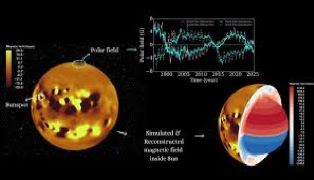
Recently, researchers at IIT Kanpur have mapped the
Sun's internal magnetic field for the first time by incorporating 30 years of
observations of the Sun's surface magnetic field, obtained through satellites
in space, into a three-dimensional (3D) computational model.
Main point
¨
These findings have been
published in ‘The Astrophysical Journal Letters’ by the Department of Physics
at IIT Kanpur.
¨
This data-driven 3D
dynamo model can reconstruct the entire internal magnetic field of the Sun.
¨ The main premise is that
the magnetic fields deep within the Sun shape the surface magnetism, and
therefore their signatures are present in long-term surface observations.
¨ This study provides an
unprecedented three-decade estimate of the magnitude, structure, and evolution
of the Sun's internal magnetic fields.
¨ The Sun's cyclic magnetic
behavior is driven by the solar dynamo, which generates magnetic fields deep
within the solar interior and also causes periodic polarity reversals.
¨
Solar Dynamo: This is the
process by which the Sun generates its magnetic field through differential rotation
and convection, causing its magnetic polarity to reverse approximately every
solar cycle.
Solar Cycle
¨ The Sun is a giant ball
of electrically charged hot gas (plasma) whose movement generates powerful
magnetic fields. This magnetic field changes over time, which is known as the
solar cycle.
¨
Approximately every 11
years, the Sun's magnetic field reverses, causing its north and south poles to
switch places; it takes another 11 years for them to return to their original
positions.
¨
These magnetic changes
lead to variations in solar surface activity, including the formation of
sunspots.
Phases of the Cycl
¨ Solar Minimum: This marks the beginning of the solar cycle, when the Sun has the fewest sunspots and the lowest level of magnetic activity. This phase indicates a relatively quiet Sun. Solar Maximum: This occurs in the middle of the solar cycle, when solar activity is at its peak and the number of sunspots is highest. As the cycle progresses beyond this point, the activity gradually decreases, and a solar minimum is reached again before the start of a new cycle.