7th Quad Leaders' Summit was held in
Manila, the capital of the Philippines, with the participation of India, the
United States, Japan, and Australia
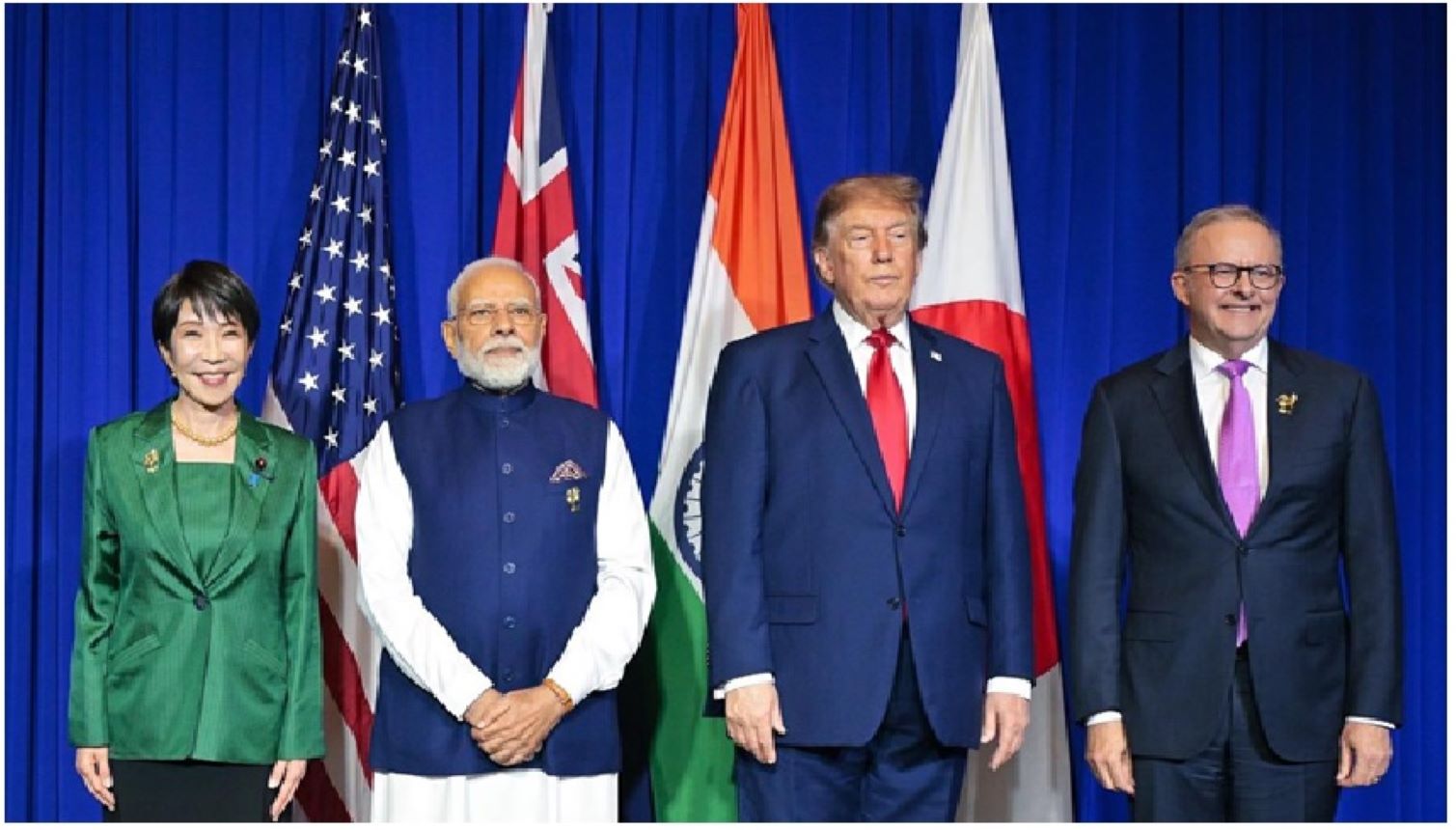
The 7th Quad Leaders' Summit was held in Manila, the
capital of the Philippines, with the participation of India, the United States,
Japan, and Australia. This was the first meeting of the leaders of the four
nations since September 2024. The objective of the summit was to strengthen
cooperation in the Indo-Pacific region and to deliberate on regional and global
challenges.
Key Outcomes of the Quad Summit
¨
Quad Business Leaders’
Forum: The first-ever Quad Business Leaders’ Forum will be hosted by India in
Mumbai in early 2027 to strengthen private-sector partnerships, promote
commercial deals and enhance economic cooperation.
¨
AI (Super Intelligence)
Accelerator: The leaders reaffirmed the AI Accelerator, announced by Quad
Foreign Ministers in Atlanta, to support trusted AI access, deployment and
technical assistance across the Indo-Pacific.
¨
The Quad countries pledged
over US$85 million for trusted AI access across the Indo-Pacific.
¨
Indo-Pacific Maritime
Surveillance Collaboration: A new initiative was launched to strengthen
information sharing and maritime domain awareness, with P-8 and P-3C patrol
aircraft scheduled to participate in their first joint maritime exercise under
the Quad framework in 2027.
¨
Cable Connectivity and
Resilience: Under the Quad Partnership for Cable Connectivity and Resilience,
Australia expanded its support for electricity cables, alongside upcoming
undersea cable projects in the Indian Ocean.
¨
Cybersecurity
Cooperation: Enhanced Quad Cybersecurity Cooperation was announced to address
rising cyber incidents and ensure an open and secure cyberspace.
¨
Counterterrorism
Cooperation: The leaders condemned terrorism, violent extremism and
cross-border terrorism and pledged to strengthen the Quad’s counterterrorism
cooperation.
¨
Regional Security and
Economic Cooperation: The leaders opposed unilateral changes to the status quo
through force or coercion and committed to securing critical supply chains and
freedom of navigation and overflight.
Quad
¨
The Quadrilateral
Security Dialogue is a diplomatic partnership comprising India, Australia,
Japan and the United States, committed to promoting a free, open, inclusive,
peaceful and prosperous Indo-Pacific.
¨
Origin (2004): The
grouping traces its origins to the coordinated humanitarian assistance and
disaster relief operations undertaken by the four countries following the
Indian Ocean tsunami in December 2004.
¨
First Meeting (2007): The
first meeting of Quad officials took place on the sidelines of the ASEAN
Regional Forum in the Philippines in May 2007, following an initiative by
Japanese Prime Minister Shinzo Abe.
¨
Revival (2017): After a
decade-long gap, the four countries revived the Quad through consultations held
in Manila in November 2017 on the sidelines of the East Asia Summit.
¨
Leaders’ Level (2021):
The grouping was elevated to the leaders’ level, with its first virtual summit
held in March 2021 and its first in-person summit held in September 2021 in
Washington, D.C.
¨
Nature: The Quad is an
informal diplomatic partnership without a permanent secretariat, treaty-based
framework or collective defence mechanism similar to NATO.
¨
Key Areas of Cooperation:
Maritime security, economic security, critical and emerging technologies,
cybersecurity, health security, climate change, infrastructure and humanitarian
assistance and disaster relief.
¨
ASEAN Centrality: The
Quad consistently supports ASEAN centrality and unity and promotes cooperation
with regional institutions, including ASEAN and the Pacific Islands Forum.
Significance of the Quad
¨
Indo-Pacific Security:
The Quad strengthens maritime security, maritime domain awareness and freedom
of navigation and overflight in the strategically important Indo-Pacific
region.
¨
Countering China’s
Influence: The grouping provides a platform for coordinating responses to
China’s growing military presence, unilateral actions and economic coercion in
the Indo-Pacific.
¨
Economic and
Technological Resilience: Cooperation in critical minerals, resilient supply
chains, artificial intelligence, cybersecurity and undersea cables strengthens
regional economic and technological security.
¨
India’s Strategic
Interests: The Quad enhances India’s strategic partnerships, strengthens its
role as an Indo-Pacific security provider and supports its vision of a free,
open and rules-based regional order.
Challenges Faced by the Quad
¨
Divergent Strategic
Priorities: Differences in the foreign policy objectives, security priorities
and strategic interests of the four members can limit collective
decision-making.
¨
China’s Economic
Interdependence: Extensive economic and trade relations with China create
difficulties for Quad members in adopting a common approach towards Beijing.
¨
Lack of Institutional
Framework: The absence of a permanent secretariat, binding commitments and
collective decision-making mechanisms can affect policy continuity and
implementation.
¨
Uncertainty in US
Engagement: Changes in US foreign policy priorities, leadership and commitment
to the Indo-Pacific can create uncertainty regarding the long-term cohesion of
the grouping.