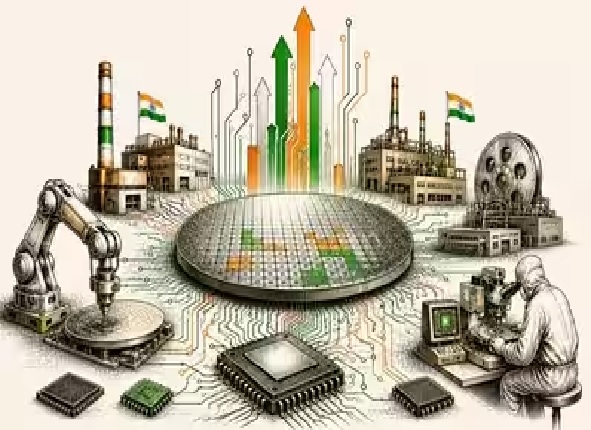
India is developing an integrated semiconductor and Artificial Intelligence (AI) ecosystem to strengthen technological self-reliance, build resilient supply chains, promote innovation, and establish itself as a leading global technology hub. The initiative is part of India’s broader strategy to move beyond being a technology consumer and become a major centre for technology design, manufacturing, research, and innovation.
India’s Semiconductor Ecosystem
¨ The India Semiconductor Mission (ISM) was launched in December 2021, with the Semicon 1.0 programme receiving an outlay of ₹76,000 crore to build India’s semiconductor ecosystem covering chip design, fabrication, packaging, testing, equipment, materials and skilled talent.
¨ Semicon 2.0 was approved in July 2026 with an outlay of ₹1,27,500 crore, expanding the focus to chip design, semiconductor equipment and materials, fabrication facilities, advanced packaging, research and development, and talent development.
¨ Manufacturing and Design Capabilities: 12 semiconductor projects have been approved across six states, involving investment commitments of more than ₹1.64 lakh crore, with three facilities already commencing commercial production.
¨ The projects cover silicon and compound semiconductor fabrication, display fabrication and advanced packaging, supporting sectors such as automobiles, telecommunications, aerospace, power electronics and consumer electronics.
¨ Indigenous Chip Design: The Design Linked Incentive (DLI) Scheme was launched in December 2021, while the Chips to Start-up (C2S) Programme was launched in 2022 to strengthen indigenous semiconductor design and skilling.
¨ Seven chips have been successfully fabricated from 16 tape-outs, including designs at advanced 12-nanometre nodes.
¨ Global Partnerships: India’s semiconductor ambitions are supported by partnerships with the United States, Japan, Singapore, the Netherlands, Germany and the European Union.
¨ Semicon India 2025 brought together more than 350 exhibitors and participants from 48 countries and regions, with 12 Memorandums of Understanding announced.
India’s Artificial Intelligence Ecosystem
¨ The IndiaAI Mission was approved in March 2024 with an outlay of ₹10,371.92 crore over five years to build a robust and inclusive AI ecosystem.
¨ The Mission has seven pillars covering AI compute, foundation models, AI datasets, application development, future skills, startup financing, and safe and trusted AI.
¨ AI Compute and Infrastructure: Shared computing capacity has expanded to 45,000+ GPUs, providing affordable access to high-performance computing for Indian startups, researchers and academia and helping democratise AI innovation.
¨ AI-ready Data and Multilingual AI: AIKosh provides access to AI-ready datasets and AI models, while Bhashini provides multilingual datasets and language technologies to support AI applications across India’s linguistic diversity.
¨Indigenous AI Capabilities: India is supporting indigenous foundation models, including initiatives such as BharatGen, to develop multilingual and multimodal AI suited to Indian languages, needs and contexts.
¨ Responsible AI, Research and Skills: Under the Safe & Trusted AI pillar, projects address bias, deepfakes, privacy, explainability and AI risks, while 58 Artificial Intelligence Centres of Excellence and 543 Data & AI Labs are being developed to strengthen AI research and skills.
Significance of the Semiconductor & AI Revolution
¨ Technological Self-Reliance and Resilience: Domestic semiconductor manufacturing, indigenous chip design and AI capabilities can reduce foreign dependence and strengthen supply-chain resilience.
¨ Strategic and Economic Significance: Semiconductors are critical for key sectors, while AI is increasingly important for research, innovation, governance and public-service delivery.
¨ Innovation and Employment: Access to EDA tools, GPUs, datasets, AI infrastructure and research facilities can lower entry barriers and create high-value employment.
¨ Global Technology Leadership: Integrating chip manufacturing, indigenous design, advanced computing, AI models, data and research can strengthen India’s technological capabilities and support the vision of Viksit Bharat.
India’s Integrated Semiconductor and AI Ecosystem
India’s
Integrated Semiconductor and AI Ecosystem