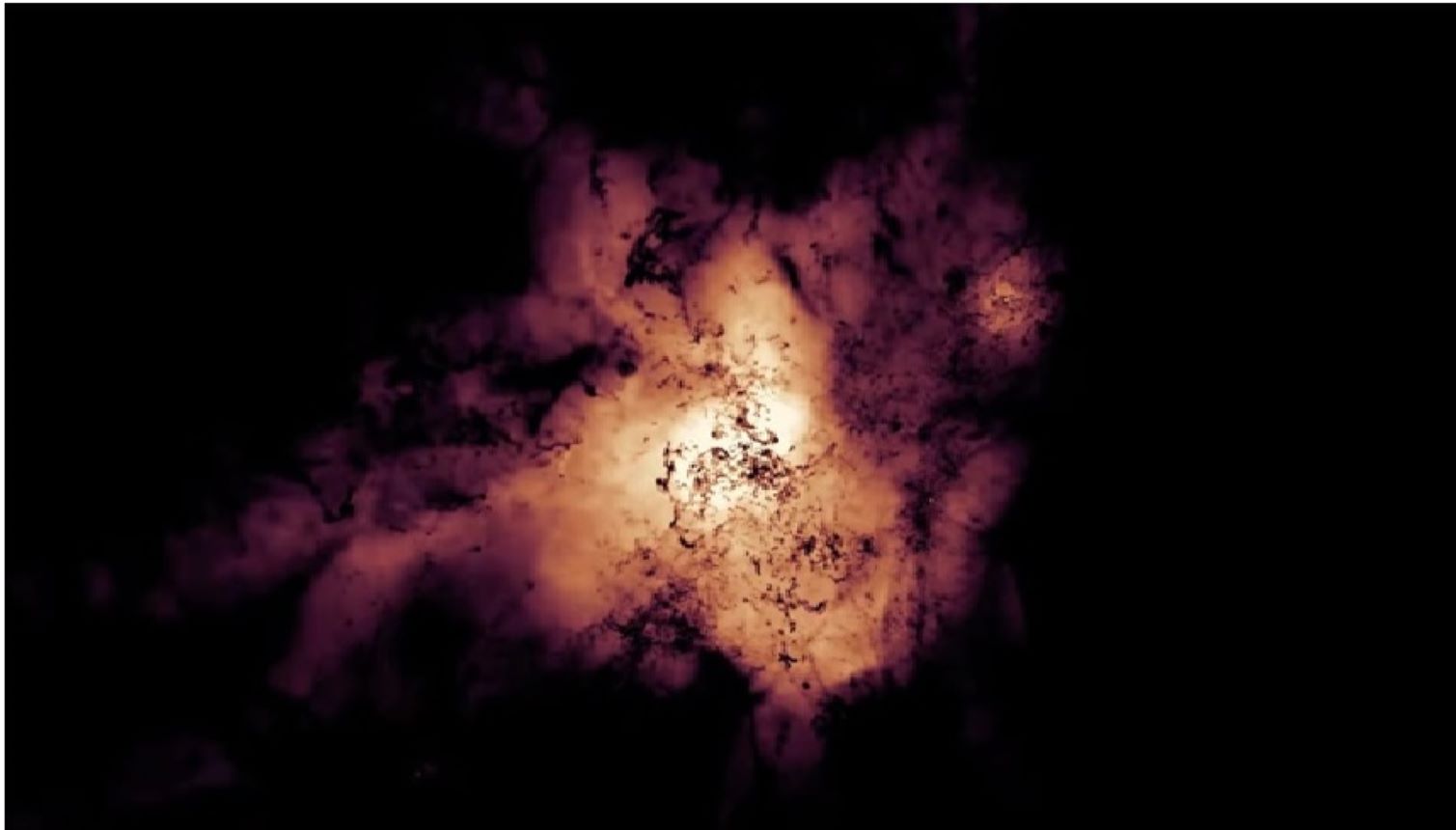
Researchers from the Center for
Astrophysics | Harvard & Smithsonian, MIT and Harvard University unveiled a
cosmological simulation named Lumina
¨
Researchers from the
Center for Astrophysics | Harvard & Smithsonian, MIT and Harvard University
unveiled a cosmological simulation named Lumina on 26 October 2026.
¨
Lumina simulates the
first two billion years of the universe.
¨
It models interactions
among ordinary matter, dark matter and radiation.
¨
The simulation covers a
region approximately 1.5–1.6 billion light-years across on each side.
¨
According to the Big Bang
theory, the universe expanded from an initially hot and extremely dense state.
¨
During the first billion
years of the universe, gas accumulated under gravity, leading to the formation
of the first stars and galaxies.
¨
Black holes also
developed during this period.
¨
Lumina simulates the
processes of hydrogen and helium reionisation.
¨
Reionisation is the
process in which energetic radiation ionises neutral atoms in intergalactic
gas.
¨
Hydrogen and helium are
the two most abundant elements in the universe.
¨
Lumina was run on the
Frontier supercomputer at Oak Ridge National Laboratory in Tennessee, USA.
¨
The computation used more
than 15,000 Graphics Processing Units (GPUs) and over 100,000 Central
Processing Unit (CPU) cores.
¨
Lumina covers a
simulation volume more than 100 times larger than those of previous comparable
simulations.
¨
Its predictions can be
compared with telescope observations to test models of cosmic evolution.
¨ The James Webb Space Telescope (JWST) primarily observes the universe in infrared wavelengths.
¨ The Nancy Grace Roman Space Telescope is a NASA space observatory designed to conduct wide-field astronomical surveys.