Rise of Mahajanapadas
- The Buddhist text Anguttara Nikaya gives the list of sixteen
Mahajanapadas at the time of Buddha.
- These
Mahajanapadas extended from the North western Pakistan to east Bihar and from
Himalayas to the river Godavari.
|
Mahajanapada |
Capital |
Area |
|
Anga |
Champa |
Bhagalpur, Munger (Bihar) |
|
Magadha |
Rajgriha |
Patna, Gaya (Bihar) |
|
Kasi |
Varanasi |
Near Varanasi |
|
Kosal |
Saketa, Sravasti |
Eastern Uttar Pradesh |
|
Vajji (Ganasangha) |
Vaishali |
Muzaffarpur (Bihar) |
|
Malla |
Kusinara/Pava |
Gorakhpur (U.P.) |
|
Chedi |
Suktimati |
Bundelkhand (U.P.) |
|
Vatsa |
Kaushambi |
Allahabad (U.P.) |
|
Kuru |
Indraprastha |
Meerut Delhi region |
|
Panchal |
Ahicchatra, Kampilya |
Western U.P. |
|
Sursena |
Mathura |
Mathura (U.P.) |
|
Gandhar |
Taxila |
Peshawar (Pakistan) |
|
Kamboja |
Rajpura |
Near Gandhar |
|
Asmak |
Paithan |
Godhavari area (M.H.) |
|
Avanti |
Ujjain, Mahishmati |
Malwa region |
|
Matsya |
Viratnagar |
Near Jaipur |
- Kashi was famous for its cotton
textiles and market for horses.
- Champa was noted for its trade and Commerce.
- Vajji represented a confederacy of eight clans.
- The Buddha died in the vicinity of Kusinara.
- The Northern Panchalas had their capital at Ahicchatra.
- The Southern Panchalas had their
Capital at Kampilya.
- Viratnagar was used as the hiding
place by Pandavas.
- Mathura was
located at the junction of two famous trade routes i.e. Uttrapatha and
Dakshinapatha.
- The Kambojas were
regarded as uncultured by the Brahamanical texts.
- The Buddha calls himself Kosalan in the Majjhima Nikaya.
- Kashi had emerged as a cloth manufaturing centre by the time of Buddha
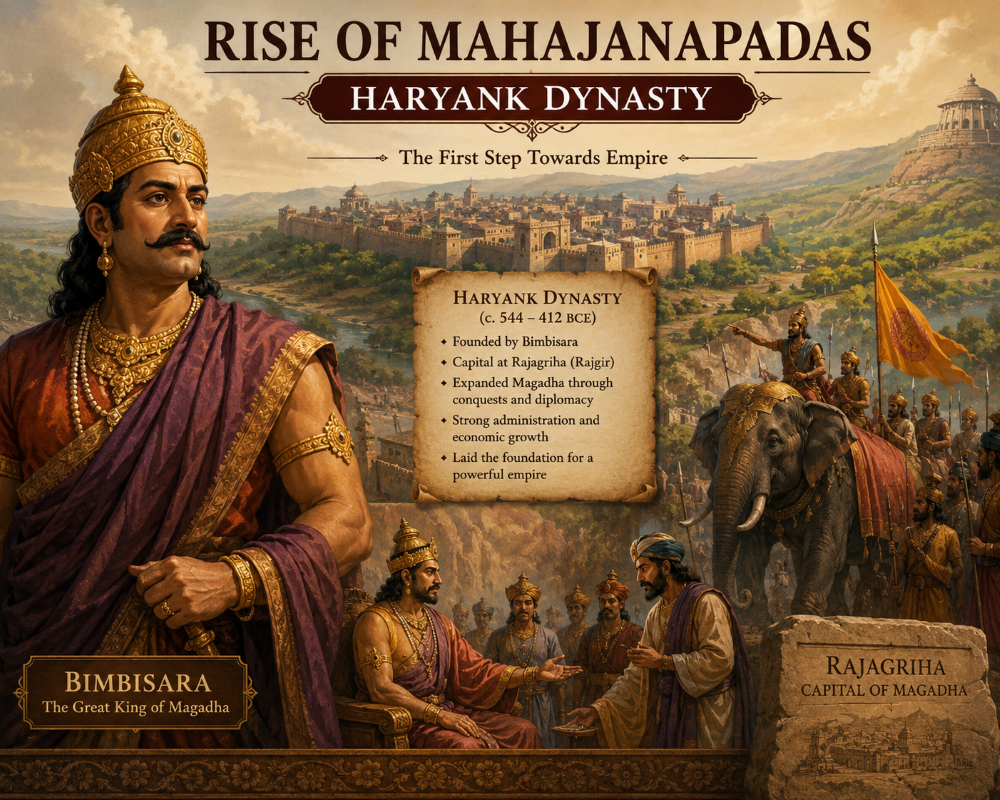
Haryank Dynasty (544 BCE – 412 BCE)
- The
epic Mahabharata has provided information about the early period of Magadha.
- Jarasandh
and Brihdrath were the rulers during the period of Mahabharata.
- Girivraja
was the magadhan capital during the early period.
Bimbisara (544-492 B.C.)
- Bimbisara established Haryank dynasty.
- Rajgir was the
capital of the state.
- Bimbisara ascended the throne in 544
B.C.
- In Jain literature he
has been called as ‘Shrenika.
- Bimbisara had three
wives, Mahakosala, Chellana and Kshema.
- Mahakosala was the
sister of Kosal ruler Prasenjit and Chellana was Lichchhavi Princess.
- Bimbisara defeated
Anga and annexed it.
- Bimbisara was contemporary
of Buddha.
- Bimbisara send his
physician Jivak to treat Chand Pradyot of Avanti
- Bimbisara was
prisoned by his son Ajatshatru and died in 493 B.C.
Ajatshatru (492-460 B.C.)
- Ajatshatru sat on
Magadha throne in 492 B.C.
- Ajatshatru followed
an expansionist policy.
- After a long struggle
he defeated Kasi and Vajji confederacy.
- Ajatshatru took the
services of his minister Vassakar to divide the Vajji confederacy.
- Ajatshatru got a
large stupa constructed in Rajgriha.
- Gautama Buddha died
during his reign; arranged the first Buddhist council.
- Ajatshatru
constructed a fort around Rajgriha to protect it from Lichcchavi attack.
- Ajatshatru was killed
by his son Udayin in 461 B.C.
- Udayin transferred
the Capital to Patliputra.
- Udayin was a follower
of Jainism.
- The last Haryank
ruler was Nagdasak.
Shisunaga Dynasty (412-344 B.c.)
- Nagdasak was killed
by his minister Shisunaga.
- Shisunaga established
Shisunaga dynasty in 412 B.C.
- Shisunaga annexed
Avanti to Magadha.
- Shisunaga established
his capital at Vaishali.
- Kalashoka came to the
throne in 344 B.C.
- Kalashoka again
transferred the capital to Pataliputra.
- During the reign of
Kalashoka second Buddhist council was organized at Vaishali.
- Nandivardhan was the
last Shisunaga ruler.
Nanda Dynasty (344-323 b.c.)
- Nanda Dynasty was established by
Mahapadmananda.
- According to Puranas he was not a Kshatriya.
- Mahapadmananda was
known as Ekarat and Sarvakshatrantaka.
- Mahapadmananda
conquered Kalinga.
- Last Nanda ruler was Dhanananda.
- Dhanananda was the
contemporary of Alexander.
- Alexander attacked
India in the reign of Dhanananda (the last ruler)
- The Nandas were
fabulously rich and enormously powerful.
- Nanda Dynasty was
destroyed by Chandragupta Maurya and Chanakya.
- Nandas have been
termed as first empire builders of India.
Factors for the Rise of Magadha
- Magadha enjoyed an
advantageous geographical position.
- Iron deposits were
situated close to Rajgir, the earliest capital of Magadha.
- Rajgir and Pataliputra were situated
at very strategic points.
- Pataliputra was surrounded by rivers
from all sides it was called as jaladurga (water-fort).
- Magadha lay at
the centre of the middle Gangetic plain.
- Magadha for the first time used
elephants on a large scale in wars.
- Greek sources have
mentioned that the Nandas maintained 6000 elephants.
- Magadha society was
unorthodox and was recently Aryanized.
- Ambitious rulers like
Bimbisara, Ajatshatru and Mahapadma nanda established Magadha as a powerful kingdom.
Foreign Invasion
- North-West India was
ruled by smaller principalities like Kambojas and Gandharas.
- The Period of 6th
century B.C. marked by political instability in North-West India.
- In 516 B.C. the
Iranian ruler Darius penetrated into North-West India.
- Darius annexed
Punjab, west of Indus and Sindh.
- This area constituted the 20th
kshatrapy (province) of Iran.
- The Indian Kshatrapy included Sindh,
the North-West frontier and part of Punjab.
- The Indian Kshatrapy paid a tribute of
360 talents of Gold.
- Xerxes, the successor of Darius,
employed Indians in the long war against the Greeks.
- The Iranian Scribes brought into India
Kharoshti script.
- Under the leadership of Alexander of
Macedonia, the Greeks destroyed the Iranian Empire.
- Alexander marched to India through the
Khyber Pass in 326 B.C.
- Ambhi was the king of Taxila.
- Porus ruled between Jhelum and Ravi.
- Porus provided a strong resistance to
Alexander.
- Alexander remained in India for 19
months (326-325 B.C.).
- Alexander’s campaign opened up four
distinct routes by land and sea.
- Alexandria and Boukephala were Greek
settlements which were established in the North West.
- Alexander’s historian Nearchus has
left valuable geographical accounts.
- Battle of Hydaspes was fought between
Porus and Alexander.
- Alexander sent 20,000 oxen to
Macedonia for use in Greece.
- The Sati system and slave trade was
prevalent in the society.
- Alexander’s invasion paved the way for
the expansion of Mauryan Empire in North West India.
Effects of Alexander’s Invasion
- It exposed India to Europe by opening
up four distinct lines of communication three by land and one by sea.
- The Hindu and the
Buddhist religious faiths and philosophies had an impact of the Greek world of
philosophy following Alexander’s time.
- Due to cultural contacts, a
cosmopolition school of art came up in Gandhara.
- It paved the way for the unification
of North India under chandragupta by weakening small states.