Saxifraga candelabrum has been
scientifically confirmed as a carnivorous plant
¨
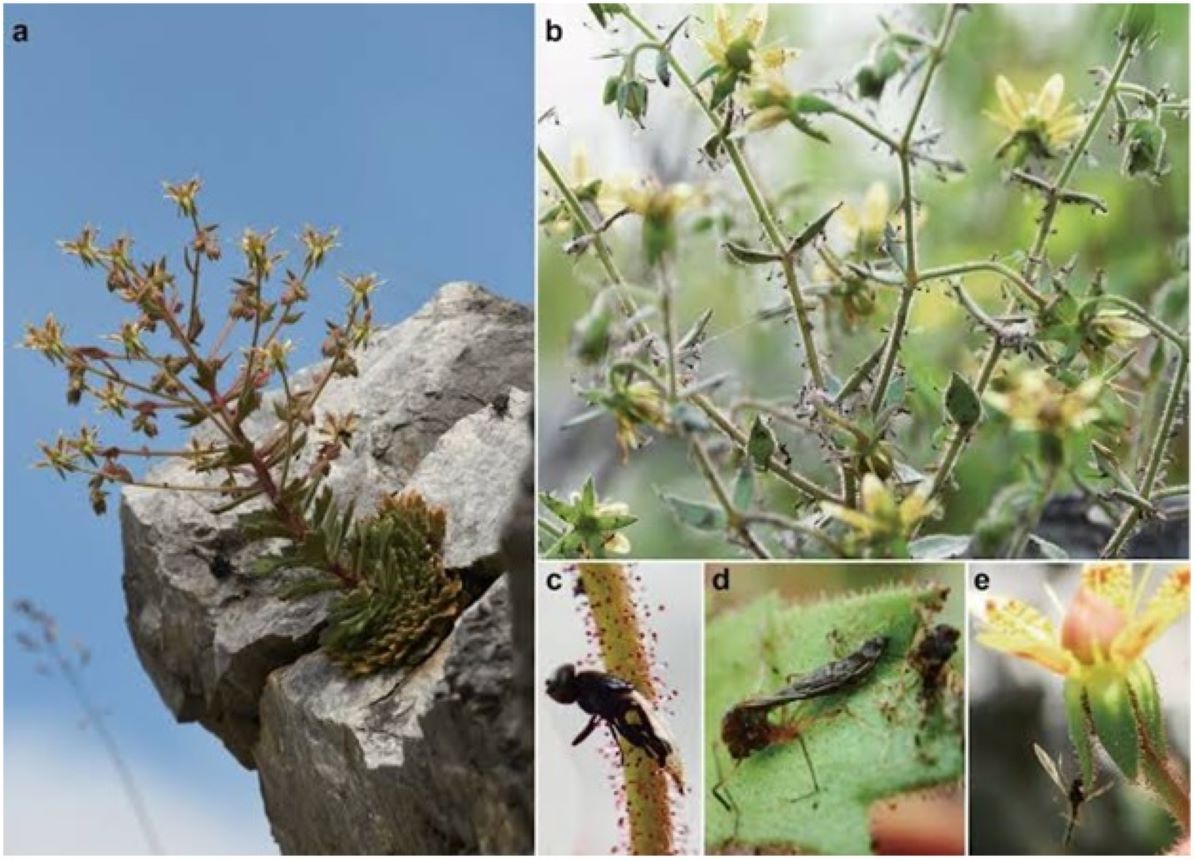
Saxifraga candelabrum has
been scientifically confirmed as a carnivorous plant.
¨
It is an alpine flowering
plant native to the Qinghai-Tibet Plateau and Hengduan Mountains of China.
¨
The finding was published
in Nature Communications on 4 August 2026.
¨
The discovery provides
evidence supporting Charles Darwin’s 1875 hypothesis that some Saxifraga
species may trap and digest insects.
¨
Carnivorous plants are
flowering plants that capture, digest, and absorb nutrients from animals,
mainly insects.
¨
They generally grow in
nutrient-poor habitats where nitrogen and phosphorus are limited.
¨
Saxifraga candelabrum
grows at elevations above 2,500 metres.
¨
It traps insects using
reddish, sticky glandular hairs present on its stems and branches.
¨
Mature plants were found
to capture an average of about 70 small insects.
¨
The insects were mainly
gnats, while larger pollinating flies were not trapped in the same manner.
¨
Researchers used
fluorescence tagging for phosphatase activity and nitrogen isotope tracking.
¨
These methods confirmed
that the plant digests captured insects and absorbs nitrogen from them.
¨
The study was conducted
by researchers from the Kunming Institute of Botany, Chinese Academy of
Sciences, and the Florida Museum of Natural History.