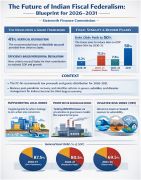
16th Finance Commission Report
The role of the Finance Commission in India's fiscal
federalism is extremely important. The report of the 16th Finance Commission
was presented to Parliament on February 1, 2026, and will be applicable for a five-year
period from 2026-27 to 2030-31. This report sets out a new framework for the
distribution of resources between the Centre and the States.The Finance
Commission is constituted under Article 280 of the Indian Constitution, with
the primary objective of ensuring a fair distribution of tax revenues between
the Centre and the States. The 16th Finance Commission was chaired by
[Chairman's name, if necessary, can be added], and included expert members from
the fields of economics, public finance, and administration.
More on the News
¨
The President of India
had constituted the 16th Finance Commission on 31 December 2023 under the
chairmanship of Dr. Arvind Panagariya.
As per the Terms of Reference (TOR), the
XVIFC was mandated to submit a report covering a five-year period, making
recommendations on:
¨
Distribution of the net
proceeds of taxes between the Union and the States.
¨
Allocation among the
States of their respective shares of such proceeds.
¨
Grants-in-aid to States.
¨
Review of arrangements
for financing Disaster Management initiatives, among other matters.
Key Recommendations of the 16th Finance
Commission
¨
Share of States in
Central Taxes: The Commission retained the previous share vertical devolution,
keeping states’ share in the divisible pool of central taxes at 41%.
¨
However, the horizontal
devolution has been revised through changes in the previous six criteria to
balance equity and efficiency across states.
¨
Fiscal Roadmap: The
Commission has recommended that the Centre should bring down the fiscal deficit
to 3.5% of GDP by 2030-31.
¨
For States, it
recommended the annual fiscal deficit limit for states to be 3% of GSDP. It
also recommended strictly discontinuing the practice of off-budget borrowings
for states and bringing all such borrowings onto their budgets.
¨
The Commission has
projected the combined debt of the central and state governments to decline
from 77.3% in 2026-27 to 73.1% of the GDP in 2030-31.
¨
Subsidy Expenditure: To
address fiscal populism, it suggested rationalising subsidy schemes and
introducing sunset clauses for non-merit subsidies.
¨
Power-Sector Reforms: The
Commission recommended that states should actively pursue the privatisation of
electricity distribution companies (DISCOMs).
¨
It proposed the creation
of Special Purpose Vehicles to absorb the legacy debt of distribution utilities
and protect private investors.
¨
Public Sector Enterprise
Reforms: The Commission recommended a review and closure of 308 inactive State
Public Sector Enterprises (SPSEs).
¨
It recommended the
formulation of a state-level PSEs disinvestment policy to target inactive and
underperforming SPSEs.
Criteria for Devolution
|
Criteria |
15th Finance
Commission (2021–26) |
16th Finance
Commission (2026–31) |
|
Income Distance |
45% |
42.5% |
|
Population (Census 2011) |
15% |
17.5% |
|
Demographic Performance |
12.5% |
10% |
|
Area |
15% |
10% |
|
Forest and Ecology |
10% |
10% |
|
Tax and Fiscal Effort |
2.5% |
10% |
|
Contribution to GDP |
100% |
100% |
Explanation of Devolution Criteria and
Recent Changes
¨
Per Capita GSDP Distance
(Income Distance): The 16th FC has defined
income distance as the difference between the per capita GSDP of a state and
the average of the per capita GSDP of the top three large states with the
highest per capita GSDP.Per capita GSDP has been computed as the average over the
period 2018-19 and 2023-24, excluding the pandemic year of 2020-21.Lower-income
states receive higher shares to promote equity.
¨
Population (2011 Census):
Distribution is based on each state’s population share as per the 2011 Census.
¨
Demographic Performance:
The 15th FC had introduced this parameter to award states for controlling
population on the basis of Total Fertility Rate (TFR). The 16th FC has
redefined the criteria to measure population growth between 1971 and 2011
instead of the TFR.States with lower population growth will have a higher share
under this parameter.
¨
Area:
It relates to devolution based on the geographical size of a State. The 16th FC
has reduced its weightage, thus limiting the advantage earlier given to
geographically large states.
¨
Forest and Ecology:
While the weight remains the same, the 16th Finance Commission has introduced
two new parameters while keeping the earlier parameters of the 15th FC.The 15th
FC had considered only dense and moderately dense forests, and defined the
parameter only in terms of share in the overall forest area.The 16th FC adds
the state’s share in the increase in forest cover between 2015 and 2023, and
also adds open forests in arriving at the total forest area.
¨
Contribution to GDP:
The 16th FC has introduced this parameter to account for the contribution to
national GDP.Contribution to GDP by a state is calculated as the squared root
of its GSDP to the sum of squared root of GSDP of all states.GSDP of each state
has been measured as the average nominal GSDP between 2018-19 and 2023-24
(excluding the pandemic year of 2020-21).
¨
Removal of Tax and Fiscal
Efforts: The earlier parameter that rewarded
higher tax collection efficiency was dropped to simplify the formula and reduce
overlap with GDP contribution.
Grants-in-aid
The 16th FC has recommended grants worth
Rs 9.47 lakh crore over the five-year period. These comprise grants for:
¨ Urban and Rural Local Bodies: The 16th FC has recommended grants worth Rs 4.4 lakh crore and Rs 3.6 lakh crore for rural and urban local bodies, respectively
¨ Disaster Management: The Commission has recommended a disaster management corpus of Rs 2,04,401 crore for State Disaster Risk Management Funds (SDRF and SDMF). The cost-sharing pattern between the centre and states is recommended to be: (i) 90:10 for north-eastern and Himalayan states, (ii) 75:25 for all other states.

.jpg)