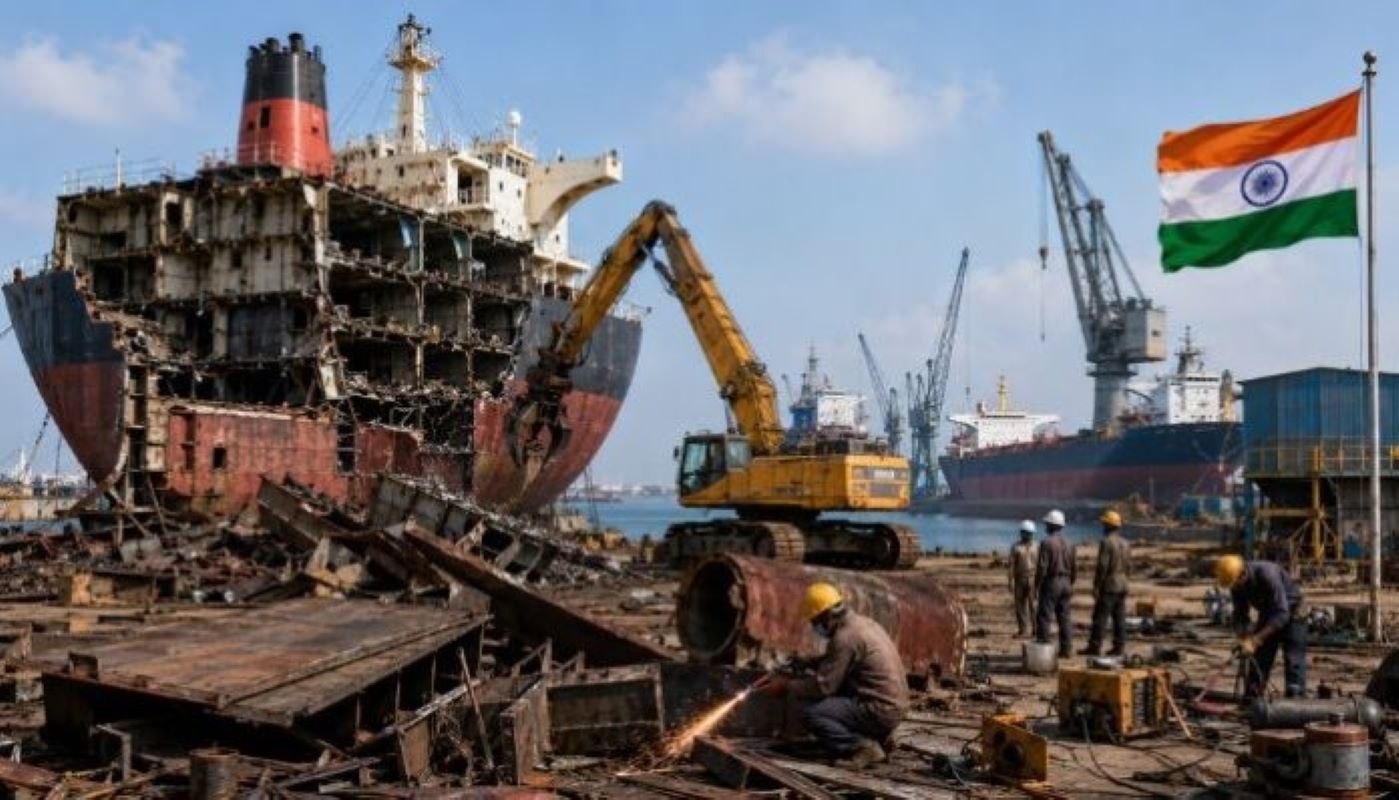
India Achieves Maritime India Vision 2030
Target Five Years Ahead by Becoming the World's Leading Ship Recycling Nation
in 2025
India has emerged as the world's leading ship
recycling nation in 2025, achieving a major target of the Maritime India Vision
(MIV) 2030 five years ahead of schedule. According to the latest report by the
United Nations Conference on Trade and Development (UNCTAD), India has secured
the top global position in ship recycling.
Key Findings of the Report
¨
India's share in global
ship recycling increased from 30.1% in 2024 to 35.4% in 2025.
¨
Ship recycling volume in
India recorded an impressive 60% increase, rising from 1.86 million Gross
Tonnage (GT) in 2024 to 2.99 million GT in 2025.
¨
India surpassed all other
countries to become the largest ship recycling nation in the world.
¨
According to the Baltic
and International Maritime Council (BIMCO), more than 16,000 ships are expected
to be recycled globally over the next decade.
¨
With its current market
share, India is well-positioned to recycle approximately 500–600 ships annually
in the coming years.
Key factors behind this achievement
¨
Policy Reforms: India has
implemented the ‘Recycling of Ships Act, 2019’, which aligns with the ‘Hong
Kong International Convention for the Safe and Environmentally Sound Recycling
of Ships’ (HKC).
¨
Modern Infrastructure:
The government has provided financial assistance of ₹53.5 crore for the
modernization of ship recycling yards, enabling 115 facilities to become
HKC-compliant.
¨
Incentive Schemes: A
‘Ship-breaking Credit Note Scheme’ has been launched, under which ship owners
receive 40% of the recycled ship's scrap value as a credit note; this can be
utilized for new ship construction at Indian shipyards.
¨
Expansion Plans: The
Alang ship recycling yard in Gujarat is being expanded, with the aim of
reaching a total recycling capacity of approximately 9 million Light
Displacement Tonnage (LDT).
Government of India Initiatives
¨
Recycling of Ships Act,
2019: Enacted to align India’s ship recycling ecosystem with the ‘Hong Kong
International Convention for the Safe and Environmentally Sound Recycling of
Ships’ (HKC). India ratified the HKC in 2019. Its objective is to ensure
environmentally sound and safe ship recycling practices.
¨
Modernization of Ship
Recycling Yards: Financial assistance of ₹53.5 crore was provided for yard
modernization. This helped 115 ship recycling facilities become HKC-compliant.
¨
Credit Note Scheme for
Ship-breaking: Ship owners receive a credit note equivalent to 40% of the scrap
value of the recycled ship. This credit note can be used to pay up to 5% of the
cost of a new ship built in an Indian shipyard. This promotes both ship
recycling and domestic shipbuilding.
¨
Inclusion in the list of
EU-approved recycling facilities: The government is making efforts to include
Indian ship recycling yards in the list approved under the European Union Ship
Recycling Regulation.
¨
Continuous engagement
with European authorities is underway to facilitate this approval.
¨
Expansion of Alang Ship
Recycling Yard: Planned expansion of the Alang ship recycling yard. The goal is
to increase national recycling capacity to approximately 9 million Light
Displacement Tonnage (LDT). The Gujarat government has prepared a comprehensive
master plan to upgrade infrastructure and meet future demand.
Maritime India Vision (MIV) 2030: Launched by the Ministry of Ports, Shipping and Waterways in 2021 as a roadmap to transform India into a leading global maritime nation. It focuses on port modernization, shipping, shipbuilding, inland waterways, logistics efficiency, sustainability, and job
 Bill, 2026.jpg)