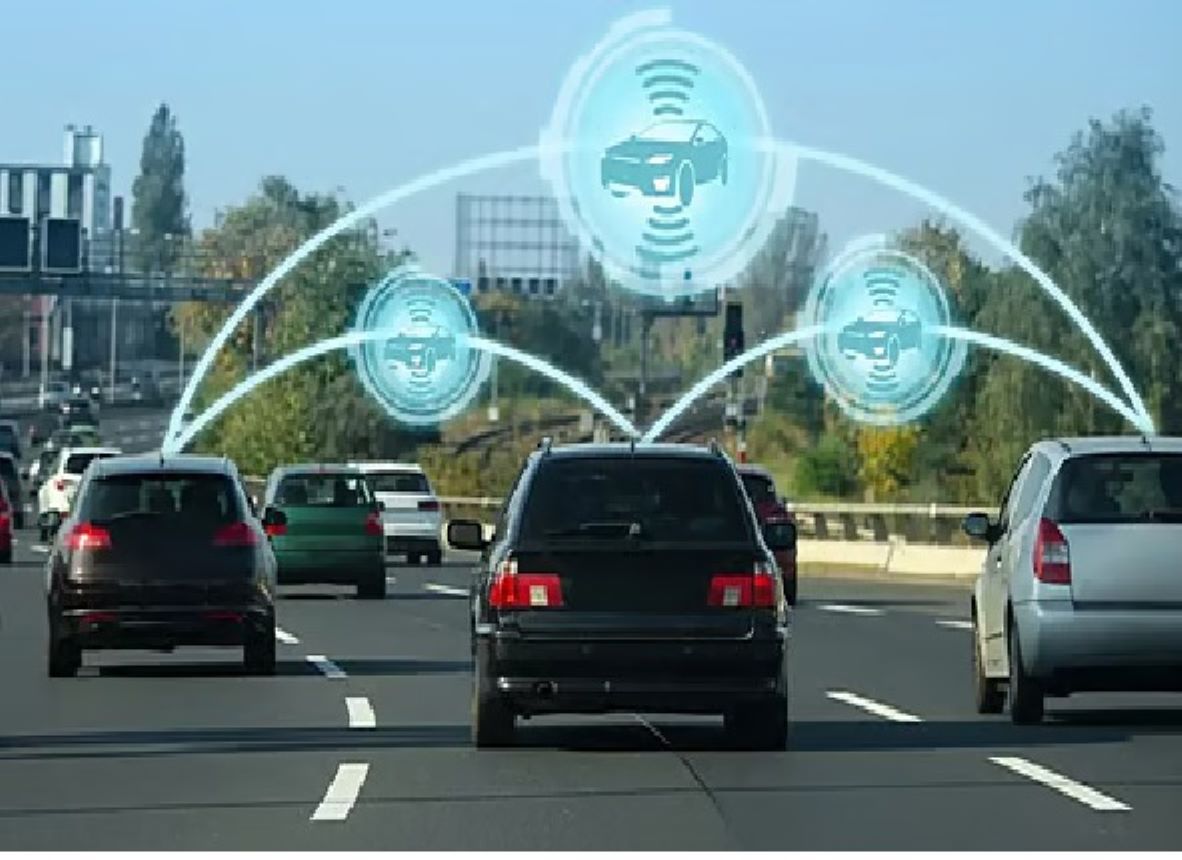
roposal to Make V2V Communication Systems
Mandatory in India
Ministry of Road Transport and Highways has issued a
draft notification proposing the phased mandatory adoption of
Vehicle-to-Vehicle (V2V) communication systems in specified motor vehicles from
1 October 2028. The proposed measure aims to strengthen road safety by enabling
vehicles to exchange important information with one another in real time.
Background
¨
The Ministry of Road
Transport and Highways (MoRTH) had constituted a Task Force to develop a
framework for Intelligent Transportation Systems (ITS) with a focus on
Vehicle-to-Everything (V2X) communication for improving road safety.
¨
The Task Force
recommended adoption of 3GPP-based Cellular Vehicle-to-Everything (C-V2X)
technology, use of the 5.875–5.925 GHz (5.9 GHz) spectrum band, and an enabling
regulatory framework for V2V deployment.
¨
Subsequently, the Telecom
Regulatory Authority of India (TRAI) released a consultation paper on the
regulatory framework for V2X communication, covering spectrum assignment,
interoperability, licensing and cybersecurity.
¨
The present draft
notification operationalises these policy initiatives by proposing the phased
deployment of Vehicle-to-Vehicle (V2V) communication systems in motor vehicles.
Key Highlights of the Draft Notification
Two-stage Implementation:
¨
From 1 October 2027:
Newly manufactured L, M and N category vehicles if fitted with V2V
communication systems must comply with AIS-230.
¨
From 1 October 2028:
Newly manufactured L, M and N category vehicles must be equipped with
AIS-230-compliant V2V communication systems.
¨
Under the Central Motor
Vehicles Rules, L denotes two- and three-wheelers, M denotes passenger vehicles
with at least four wheels, and N denotes goods vehicles.
¨
Road Safety Objective:
V2V systems will enable vehicles to exchange real-time safety information and
provide advance warnings for situations such as Emergency Brake Alert, Forward
Collision Warning, Wrong-way Driving and Emergency Vehicle Alert, thereby
helping reduce road accidents.
¨
AIS-230 Standard:
Specifies the minimum technical, functional, radio performance, environmental
and cybersecurity requirements for factory-installed On-Board Units (OBUs)
using Cellular Vehicle-to-Everything (C-V2X) technology in the 5.875–5.925 GHz
frequency band.
¨
Enabling Regulatory
Framework: The proposal follows the licence-exempt use of the 5.875–5.925 GHz
frequency band for ITS/V2X applications and has been released for stakeholder
consultation before final notification.
Understanding Vehicle-to-Vehicle (V2V)
Communication
¨
Overview:
Vehicle-to-Vehicle (V2V) Communication is a wireless technology that enables
nearby vehicles to exchange real-time information such as position, speed,
direction, acceleration and braking status, including safety information beyond
the driver’s direct line of sight.
¨
Working Mechanism:
Vehicles equipped with factory-installed On-Board Units (OBUs) continuously
exchange real-time safety information using Cellular Vehicle-to-Everything
(C-V2X) technology, enabling early detection of potential collision risks.
Key Advantages:
¨
Extends situational
awareness beyond the range of onboard sensors and the driver’s field of vision.
¨
Enables cooperative
collision avoidance through timely exchange of safety information.
¨
Supports proactive
accident prevention by complementing vehicle safety systems.


 Bill, 20ning India’s Civil Registration System.jpg)