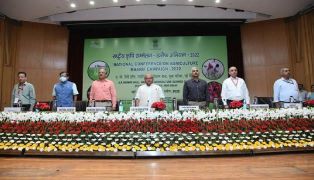
Agricultural workshop inaugurated in New
Delhi
Review Workshop of NICRA and the Launch-cum-Use Case
Workshop of ACASA–India (Atlas of Climate Adaptation in South Asian
Agriculture) was inaugurated in New Delhi by the Secretary of the Department of
Agricultural Research and Education (DARE) and Director General of the Indian
Council of Agricultural Research (ICAR). The workshop, jointly organised by
ICAR and the Borlaug Institute for South Asia (BISA), marked a major milestone
by synthesising 15 years of learning from NICRA.
Atlas of Climate Adaptation in Indian
Agriculture (ACASA–India)
¨
It is a web-enabled
digital platform developed by the ICAR-led National Agricultural Research and
Education System (NARES) in collaboration with BISA–CIMMYT.
¨
The platform is designed
to support location-specific, data-driven adaptation planning, enabling
policymakers, researchers and practitioners to design targeted climate
adaptation strategies across diverse agro-ecological regions.
¨
It is part of a regional
Atlas initiative for South Asia designed to integrate climate science with
adaptation actions for smallholder farmers, policymakers, researchers, and
other stakeholders. A Regional Atlas Initiative for South Asia refers to a
collaborative, data-driven programme led by Borlaug Institute for South Asia
(BISA) that develops shared, high-resolution digital atlases to support climate
change adaptation and resilience across South Asian countries. National
partners include: India (ICAR), Bangladesh, Nepal and Sri Lanka.
Key Features
¨
Spatial Assessment:
Climate risks are mapped at about 25 sq. km grid, roughly covering 4–5
villages, enabling detailed, local-level insight.
¨
High-Resolution Data:
Uses granular climate datasets, scientific modeling, and expert validation to
assess exposure, vulnerability, and risk patterns.
¨
Localized adaptation: The
platform provides contextual adaptation strategies tailored to specific
locations, crops and livestock.
¨
Digital Public
Infrastructure: The Atlas offers open-source data, codes, and scripts to enable
research, policy analysis, and customized adaptation planning.
¨
User-Friendly Digital
Platform: Designed as a dynamic and interactive digital tool, it supports
real-time query, visualization, and decision-making.
Significance of the Report
¨
Mainstream climate-smart
agriculture: It reinforce India’s commitment to science-driven, data-enabled
and inclusive climate action in agriculture, positioning the country as a
leader in climate-resilient agri-food systems globally.
¨
Facilitates Climate
Finance: By quantifying risks and identifying adaptation pathways, ACASA
supports targeted climate finance, including insurance products and credit
mechanisms.
¨ Capacity Building: With open datasets and analytical tools, Researchers and institutions can use to innovate in climate adaptation science.
¨ Regional Collaboration: As a South Asia-wide initiative (with partners from Bangladesh, Nepal, Sri Lanka, and India), the Atlas promotes cross-border knowledge sharing on climate adaptation.

.jpg)