¨ Australian Institute of Marine Science (AIMS) released its 2025/26 Long-Term Monitoring Program Annual Summary Report.
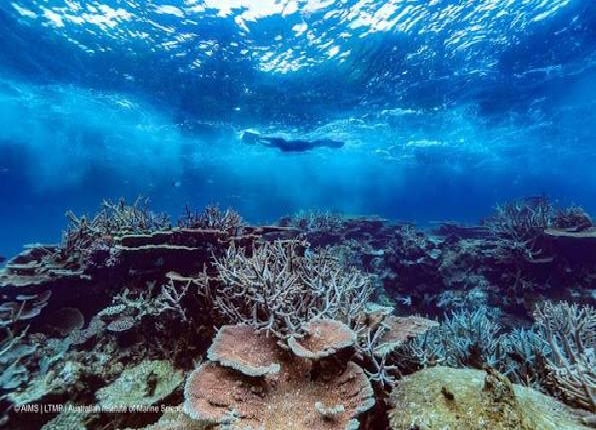
¨ The report recorded a rebound in hard coral cover in parts of the Great Barrier Reef after severe coral bleaching in previous years.
¨ The Great Barrier Reef is the world’s largest coral reef system and is located off the north-eastern coast of Australia in the Coral Sea.
¨ Hard coral cover refers to the percentage of reef surface occupied by living hard corals and is an important indicator of reef health.
¨ In the Northern region, hard coral cover increased from a record low of 30% in 2025 to 35.1% in 2026.
¨ In the Central region, hard coral cover increased from 28.6% to 31.6%.
¨ In contrast, the Southern region recorded a decline in hard coral cover from 26.9% to 26.4%.
¨ The 2025/26 Long-Term Monitoring Program survey covered 121 reefs.
¨ Coral cover remained unchanged on 56% of the surveyed reefs.
¨ Coral cover increased on 28% of reefs, while it declined on 16%.
¨ The Long-Term Monitoring Program (LTMP) is AIMS’s long-running reef survey programme that monitors coral cover, coral mortality, and overall reef condition.
¨ The programme conducts repeated surveys across the Northern, Central, and Southern sectors of the Great Barrier Reef.
¨ A late-summer monsoon in early 2026 brought increased cloud cover and cooler sea-surface temperatures.
¨ Cooler water temperatures can help reduce thermal stress on corals during bleaching events.
¨ Scientists also identified climate-induced disruptions, cyclones, and a fifth outbreak of crown-of-thorns starfish as major pressures on the reef.
¨ Crown-of-thorns starfish are coral-eating predators that can rapidly reduce live coral cover on affected reefs.
Australian Institute of Marine Science released its 2025/26 Long-Term Monitoring Program Annual Summary Report
Australian
Institute of Marine Science released its 2025/26 Long-Term Monitoring Program
Annual Summary Report

 for 2026–27.jpg)