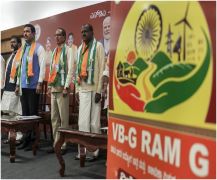
Central Government Releases Draft Rules
for the New 'Viksit Bharat – Rozgar aur Aajeevika Mission Act, 2025'
The Central Government has released the draft rules
for the new 'Viksit Bharat – Rozgar aur Aajeevika Mission Act, 2025'. This new
legislation is expected to come into force in July 2026; upon its enactment, it
will replace the Mahatma Gandhi National Rural Employment Guarantee Act
(MGNREGA), which has been operational for nearly 20 years. The government aims
to transform the rural employment program into a more modern, skill-based, and
livelihood-oriented initiative. The draft rules propose a new allocation
formula based on the decentralization criteria of the 16th Finance Commission
and introduce performance-based financing for the states.
Key Features of the Draft Rules for the
VB-G RAM Act, 2025
¨
Shift in the
"General Allocation" Financing Model: The draft rules move away from
MGNREGA's open-ended, demand-driven financing model. Central allocations will
now function as an expenditure ceiling, based on an objective horizontal
decentralization formula recommended by the 16th Finance Commission.
¨
Prioritizing Poorer
States: This formula relies primarily on 'GSDP Distance' (assigned a weightage
of 42.5%), which measures how far a state's per capita income lags behind that
of the wealthiest states, thereby ensuring that poorer states receive a larger
share. Population has been assigned a weightage of 17.5%. Following GSDP
Distance, the next highest weightage is given to Population (17.5%), which
benefits larger states; meanwhile, each of the remaining criteria in this
formula has been assigned a weightage of 10%.
¨
Revised Cost-Sharing:
Unlike MGNREGA, where the Centre bore 100% of the wage bill, the new framework
implements a 60:40 cost-sharing ratio between the Centre and most states (with
a 90:10 ratio for Northeastern and Himalayan states). Any expenditure exceeding
the general allocation must be borne entirely by the state.
¨
Performance-Based
Financing: From the second year of implementation onwards, a portion of the
central allocation will be contingent upon state-level performance parameters.
These metrics include the timely payment of wages, strict compliance with
social audit requirements, and the percentage of completed public works.
Governance and Administrative Mechanism
¨
National-Level Steering
Committee: A 16-member committee chaired by the Union Secretary for Rural
Development. Its mandate is to recommend decisions regarding general
allocations to states, set standards, and monitor guidelines.
¨
Composition: It will comprise
at least five representatives from state governments (nominated by the Centre),
as well as representatives from NITI Aayog and other Union Ministries.
¨ Central Rural Employment Guarantee Council (GRG): Chaired by the Union Minister for Rural Development, this body aims to advise the Centre on the overall implementation of the new legislation.
¨ Provisional Validity of Job Cards: During the transitional phase, existing e-KYC-verified MGNREGA job cards will remain valid until new Rural Employment Guarantee Cards are issued to the workers.

.jpg)