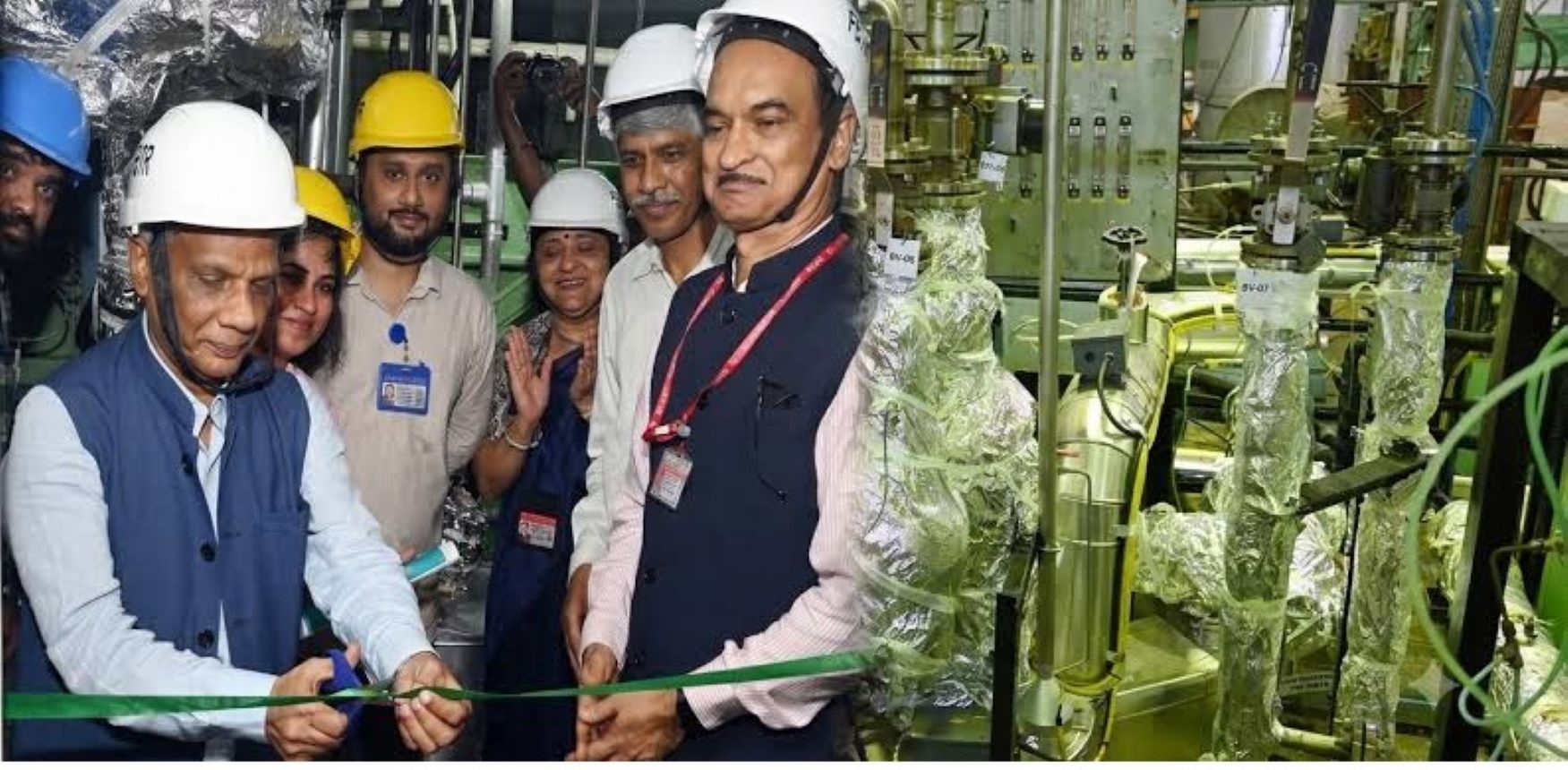
DAE Inaugurates World's First
Nuclear-Based Copper–Chlorine Hydrogen Production Facility
The Department of Atomic Energy (DAE) has inaugurated
the world's first hydrogen production facility based on the Copper–Chlorine
(Cu–Cl) thermochemical cycle at the Indira Gandhi Centre for Atomic Research
(IGCAR), Kalpakkam. The facility uses nuclear process heat generated by the
Fast Breeder Test Reactor (FBTR), marking a major milestone in clean energy,
nuclear technology, and green hydrogen production.
Hydrogen Production Facility
¨
It is the world’s first
hydrogen production facility based on the Copper–Chlorine (Cu–Cl)
Thermochemical Cycle using nuclear process heat from the Fast Breeder Test
Reactor (FBTR).
¨
The facility has been
established as a technology demonstrator to validate hydrogen production using
nuclear energy through the indigenously developed Cu–Cl process by the Bhabha
Atomic Research Centre (BARC), Mumbai.
¨
It successfully
integrates nuclear process heat with hydrogen generation, demonstrating the
feasibility of large-scale, carbon-free hydrogen production using advanced
nuclear reactors.
¨
The project is the result
of joint efforts by BARC and IGCAR, involving research, process development,
engineering design, equipment fabrication, installation, testing and
commissioning.
The facility will
¨
Generate operational data
for process validation.
¨
Facilitate optimisation
of the Cu–Cl process.
¨
Support research for
scaling up commercial nuclear-assisted hydrogen production.
Copper–Chlorine (Cu–Cl) Thermochemical
Cycle
¨
The Copper–Chlorine
(Cu–Cl) Thermochemical Cycle is an advanced hydrogen production process that
uses nuclear process heat to split water into hydrogen and oxygen through a
series of thermochemical reactions.
¨
The process involves
multiple thermochemical reactions in which copper and chlorine compounds are
continuously recycled, while water is ultimately split into hydrogen and
oxygen.
¨
The process has been
developed indigenously by the BARC.
¨
It utilises
high-temperature process heat generated from the Fast Breeder Test Reactor
(FBTR) instead of relying on fossil fuels.
¨
The process produces
carbon-free (Pink) Hydrogen by utilising nuclear energy as the primary heat
source.
¨
Nuclear reactors provide
continuous high-temperature process heat, enabling round-the-clock hydrogen
production unlike intermittent renewable sources.
It is considered one of the most promising
thermochemical hydrogen production technologies because of
¨
Relatively lower
operating temperatures compared to many other thermochemical cycles.
¨
Higher thermodynamic
efficiency.
¨
Reduced energy losses
during hydrogen production.
The process
¨
Significantly reduces
dependence on fossil fuels.
¨
Eliminates greenhouse gas
emissions associated with conventional hydrogen production.
¨
Enables production of
carbon-free (pink) hydrogen using nuclear energy.
Significance of the Facility
¨
World First Achievement:
Establishes India as the first country to demonstrate hydrogen production
through the Cu–Cl thermochemical cycle using nuclear process heat.
¨
Clean Energy Transition:
Provides a carbon-free pathway for hydrogen production, supporting India’s
decarbonisation and Net Zero ambitions.
¨
Energy Security: Reduces
dependence on imported fossil fuels by producing hydrogen using indigenous
nuclear resources.
¨
Technological
Breakthrough: Demonstrates successful integration of advanced nuclear reactors
with hydrogen production technologies.
¨
Commercial Potential:
Generates valuable operational experience for scaling up nuclear-assisted
hydrogen production for industrial and commercial deployment.
¨ Strengthening India’s
Nuclear Programme: Showcases the versatility of fast breeder reactors beyond
electricity generation by utilising high-temperature process heat.
¨
Boost to Indigenous
Innovation: Reflects the technological capabilities of BARC and IGCAR in
advanced nuclear systems and clean energy technologies.
¨ Supports India’s Three-Stage Nuclear Programme: Builds upon the expertise developed through the FBTR, which laid the foundation for the 500 MWe Prototype Fast Breeder Reactor (PFBR).
¨ Promotes AtmaNirbhar Bharat & Viksit Bharat: Reinforces India’s commitment to technological self-reliance, sustainable development and a secure low-carbon energy future.

 scheme will continue until September 30, 2026.jpg)