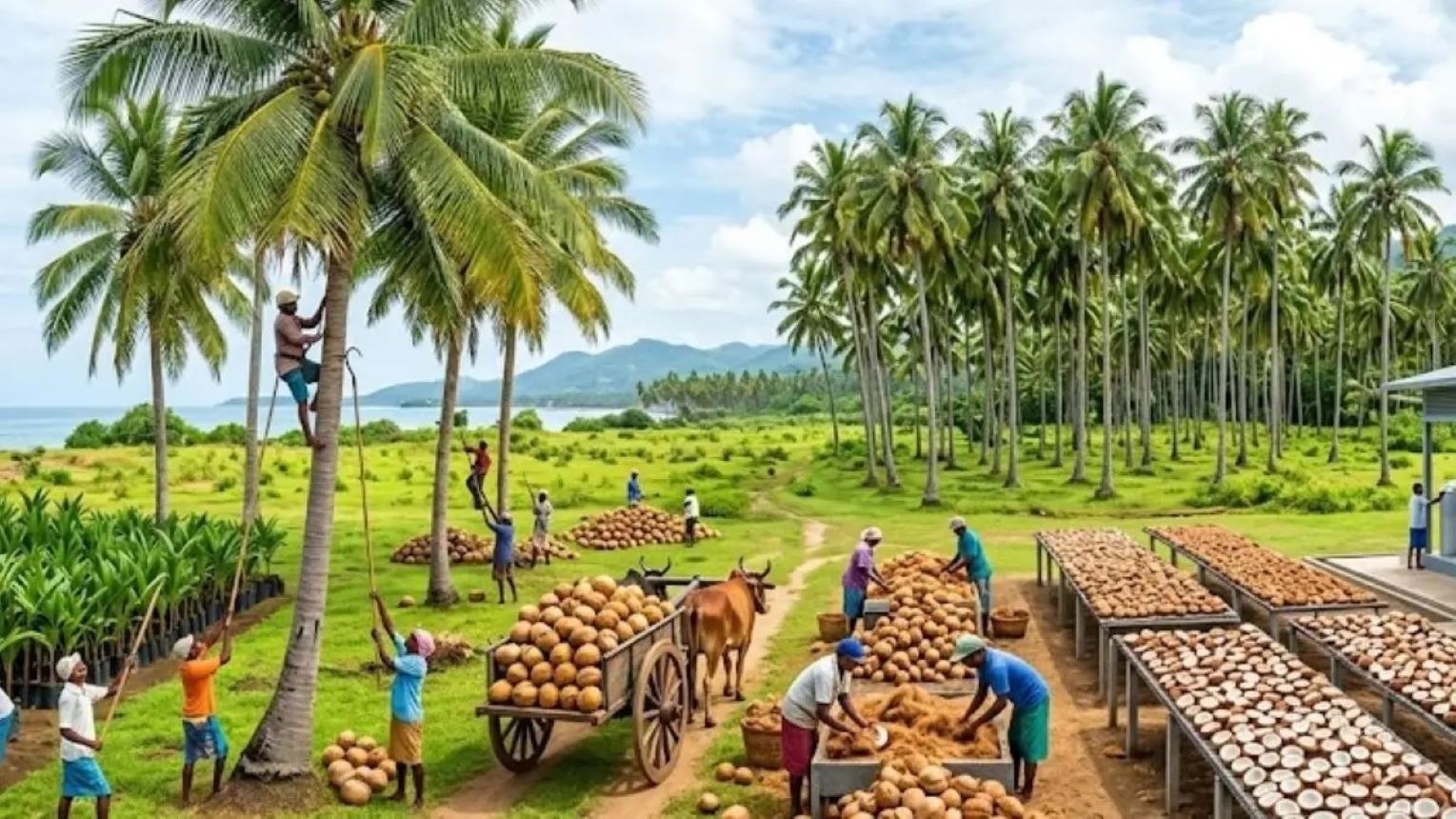
India’s Coconut Sector: Growth through
Value Addition, Productivity and Rural Livelihoods
India ranks first globally in coconut production and
third in terms of the area under coconut cultivation. The country’s coconut
sector is now moving beyond traditional farming towards value addition,
exports, higher productivity and diversification of rural livelihoods.
Coconut Production in India
¨
Coconut is an important
horticultural crop in India. It is mainly cultivated in the tropical and
coastal regions of the country.
¨
Coconut is used not only
as a food product but also for producing coconut oil, coconut water, copra,
coconut milk, coconut powder, fibre and various industrial products.
¨
Therefore, the coconut
sector is important not only for agriculture but also for processing industries
and rural enterprises.
India’s Coconut Sector
¨
India accounts for 31.24%
of global coconut production and 17.90% of global coconut area.
¨
During 2024-25, India
produced 20,301.22 million nuts from 2.19 million hectares, with average
productivity of 9,249 nuts per hectare.
¨
Kerala has the largest
area under coconut cultivation at around 7.54 lakh hectares, while Tamil Nadu
leads in production.
¨
Andhra Pradesh records
the highest productivity, followed by West Bengal and Tamil Nadu.
¨
The sector supports
nearly 30 million people, including around 10 million farmers, and remains
important for rural livelihoods.
¨
India’s coconut export
basket has diversified from traditional products to virgin coconut oil, coconut
milk, coconut water, activated carbon, fresh/frozen/grated coconut, copra and
desiccated coconut.
¨
Coconut product exports
reached ₹7,038.35 crore (USD 794.70 million) in 2025-26, a 62% increase over
₹4,349.03 crore in 2024-25.
¨
Major export markets
include the USA, UAE, Sri Lanka, Germany, Russia, Türkiye, Belgium, UK and
Netherlands.
Government Initiatives for the Coconut
Sector
¨
Expansion of Coconut
Cultivation: Financial assistance of ₹56,000 per hectare is provided for
planting coconut seedlings in new areas.
¨
Production of Quality
Planting Material: The Coconut Development Board supports Demonstration cum Seed
Production Farms, seed gardens and nurseries.
¨
Productivity Improvement:
Under the Productivity Improvement through Coconut-based Cropping System
(PICCS), assistance of ₹42,000 per hectare is provided for integrated
coconut-based farming. In 2025-26, the programme covered 18,800 hectares,
benefiting 48,696 farmers.
¨
Coconut Promotion Scheme:
Announced in Union Budget 2026-27, it focuses on quality seedlings, expansion
into potential areas, replanting and rejuvenation, crop-health management and
integrated processing units.It forms part of the ₹350-crore allocation for
high-value agriculture, including coconut, cashew and cocoa.
¨
MSP Support: Copra is
among the 22 mandated agricultural crops covered under the Minimum Support
Price regime.NAFED and NCCF are the Central Nodal Agencies for procurement.
¨
Value Addition and Export
Promotion: The government supports processing, quality certification, branding,
trade fairs, buyer-seller meets, market intelligence and export promotion to
strengthen the coconut value chain.
¨
Skill Development and
Entrepreneurship: Programmes such as Friends of Coconut Tree (FoCT), Cocomitra,
Kera Kaushal Kendra and Neera Tapping and Processing Technician Training
promote skilled employment, rural entrepreneurship and coconut-based enterprises.
¨
Technology Mission on
Coconut (TMOC): Promotes technologies for pest and disease management,
processing, product diversification, research and development and value
addition.
¨
Kera Suraksha Insurance
Scheme: Provides accident insurance coverage to coconut climbers, Neera
technicians, hybridisation workers and other coconut labourers.
Significance of the Coconut Sector
¨
Livelihood and income
diversification: The sector supports nearly 30 million people, including around
10 million farmers, while integrated and multi-tier farming systems provide
additional income opportunities.
¨
Value addition and
exports: Processing coconut into oil, milk, water, activated carbon and other
value-added products strengthens rural enterprises and India’s position in global
agricultural value chains.
¨
Employment and rural
development: Coconut-based activities such as processing, handicrafts, Neera
tapping, palm climbing and primary processing create employment and
entrepreneurship opportunities beyond cultivation.
¨
Cultural and economic
importance: Revered as the “Kalpavriksha” or Tree of Life, coconut has been
part of India’s food, medicine, fibre, timber, fuel and cultural traditions for
nearly three millennia.


 scheme will continue until September 30, 2026.jpg)