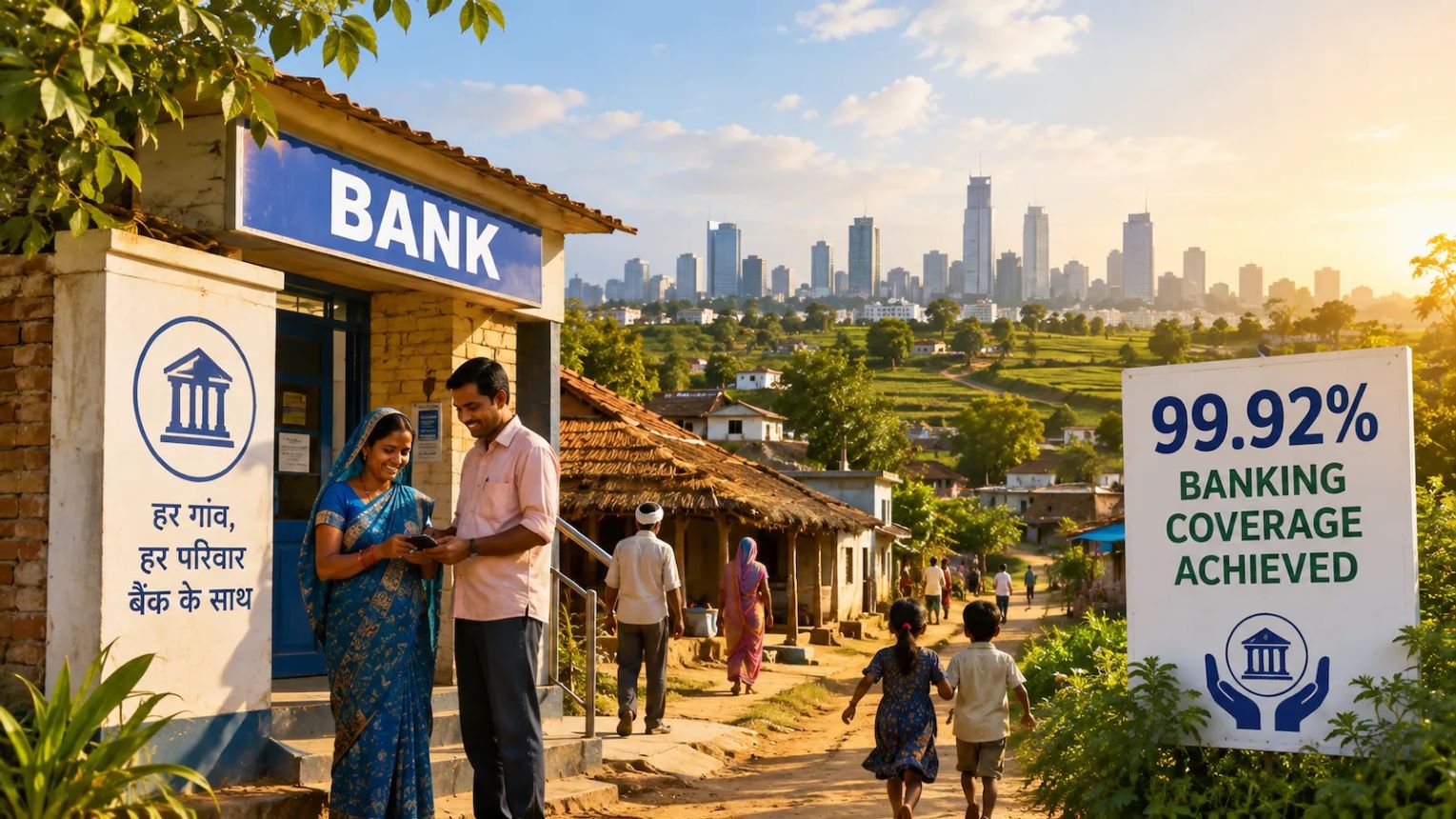
India Achieves Near-Universal Banking
Access in Rural Areas
The Government has informed Parliament that 99.92% of
India's inhabited villages are now served by a banking outlet—including bank
branches, Business Correspondents (BCs), or India Post Payments Bank
(IPPB)—within a 5-km radius. This marks a significant milestone in India's
journey toward universal financial inclusion.The expansion of banking access
has improved the availability of essential financial services such as savings
accounts, deposits, withdrawals, remittances, direct benefit transfers (DBTs),
insurance, pensions, and digital payments, particularly in rural and remote
areas.
More on the News
¨
Coverage Achieved: As of
July 2026, 6,00,868 out of 6,01,328 inhabited villages (99.92%) have access to
a banking outlet within a 5-km radius.
¨
Banking Infrastructure:
This banking expansion is supported by a robust infrastructure of over 1.81
lakh bank branches, 17.36 lakh Business Correspondents (BCs), and 1.65 lakh
IPPB centres.
¨
Remaining Gap: Remaining
uncovered villages are primarily located in difficult terrains where expansion
is constrained by connectivity, infrastructure, availability of suitable
premises and commercial viability.
¨
Implementation Mechanism:
Expansion of banking infrastructure in uncovered areas is coordinated through
the State Level Bankers’ Committees (SLBCs) and Union Territory Level Bankers’
Committees (UTLBCs) in consultation with the RBI, State Governments and banks.
Initiatives that Helped India Achieve
Near-Universal Banking Coverage
¨
Pradhan Mantri Jan Dhan
Yojana (PMJDY): PMJDY has significantly expanded access to formal banking
through 58.77 crore accounts with total deposits of over ₹3.12 lakh crore (as
of July 2026).
¨
Business Correspondent
(BC) Model: Deployment of BCs has enabled doorstep banking services, including
deposits, withdrawals, remittances and account opening in remote villages.
¨
India Post Payments Bank
(IPPB): Leveraging the extensive postal network, IPPB has significantly
strengthened banking access in rural and difficult-to-reach areas.
¨
Digital Public
Infrastructure (DPI): The JAM Trinity (Jan Dhan-Aadhaar-Mobile), Direct Benefit
Transfer (DBT), Aadhaar Enabled Payment System (AePS) and UPI have transformed
banking from branch-centric service delivery to digitally enabled financial
inclusion.
¨
Technology-enabled
Financial Inclusion: Digital initiatives such as the Jan Samarth Portal, Kisan
Rin Portal (KRP) and NABARD’s e-KYC platform have further streamlined access to
institutional credit and financial services.
Significance
¨
Near-universal Banking
Access: Coverage of 99.92% of inhabited villages has substantially reduced
geographical barriers to formal banking services across rural India.
¨
Strengthens Welfare
Delivery: Extensive banking access complements the JAM Trinity, enabling
efficient Direct Benefit Transfer (DBT) of government benefits with greater
transparency and reduced leakages.
¨
Deepens Financial
Inclusion: Expansion of BCs, IPPB and AePS, along with 58.77 crore PMJDY
accounts, has significantly expanded access to formal savings, remittances and
digital banking services.
¨
Supports Rural
Formalisation: Improved access to institutional savings, credit, insurance and
pension services reduces dependence on informal financial channels while
strengthening rural economic resilience.



 Series with Base Year 2022–23.jpg)