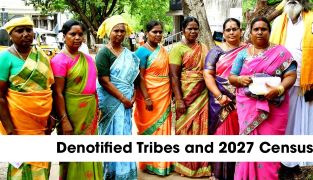
Demand for Constitutional Recognition of DNT,
NT, and SNT Communities
The Denotified Tribes (DNT), Nomadic Tribes (NT), and
Semi-Nomadic Tribes (SNT) have long been socially, economically, and
politically marginalized. Now, these communities are organizing across the
country to launch a new movement to secure their identity, rights, and
representation. They are demanding a separate schedule, similar to the
Scheduled Castes (SC) and Scheduled Tribes (ST), and a separate column in the
2027 census.
More on the News
¨
India is set to conduct a
caste enumeration in February 2027, the first such exercise since the 1931
Census, making it a critical moment for historically excluded communities.
¨
DNTs, NTs, and SNTs view
the upcoming Census as a rare opportunity to address decades of invisibility,
exclusion, and misclassification in official records.
¨
The Social Justice
Ministry has recommended the inclusion of DNTs in the upcoming Census. The
Office of the Registrar General of India (RGI) has reportedly agreed to this
inclusion.
Key Demands of Denotified, Nomadic and
Semi-Nomadic Tribes
¨
Separate Census Column:
The primary demand is for a distinct column or code in the 2027 Census to
ensure accurate counting.
¨
Constitutional
Recognition: Leaders are pushing for a “separate Schedule” for Denotified
Tribes, placing them on par with SCs, STs, and OBCs.
¨
Sub-classification:
Communities are demanding the recognition of “graded backwardness” within the
DNT umbrella to distinguish between “settled” and “nomadic” groups.
¨
Official Documentation: A
demand for State and Union Territory governments to issue proper DNT community
certificates so they can access existing welfare schemes.
Reasons Behind the Demand for Separate
Constitutional Recognition
¨
Historical
criminalisation and stigma: Denotified, nomadic and semi-nomadic tribes were
labelled “criminal tribes” under the Criminal Tribes Act, 1871, and despite its
repeal in 1952, enduring social stigma, exclusion and police profiling continue
to marginalise these communities.
¨
Political
misclassification and systemic exclusion: Most DNTs were administratively
absorbed into SC, ST or OBC lists while around 260–270 communities remain
unclassified, and even those included are crowded out by larger groups,
limiting their access to reservations, welfare benefits and representation.
¨
Census invisibility and
administrative failure: The absence of a separate census column or code has
rendered DNTs statistically invisible, which is reflected in poor welfare
delivery, such as only ₹69.3 crore being spent out of the ₹200 crore allocation
under the SEED scheme due to a lack of proper community certification.
¨
Extreme and graded
backwardness: Nomadic and semi-nomadic DNTs suffer deeper educational,
economic, and social deprivation than many settled groups within existing
categories, reflecting graded backwardness that current classifications cannot
adequately address.
¨
Emerging constitutional
support: Community leaders cite the Supreme Court’s August 2024 ruling allowing
sub-classification within SC and ST categories to argue that a separate
Schedule with internal differentiation is constitutionally justified to ensure
meaningful safeguards, dedicated quotas and effective welfare delivery for
DNTs.
Denotified, Nomadic and Semi-Nomadic
Tribes
¨
DNTs, SNTs and NTs
represent some of the most remote, marginalised, and historically oppressed
communities in India.
¨
There is no official data
on their population, but the Renke Commission (2008) put their population at
10.74 crores based on census 2001.
¨
The Idate Commission
(2017) identified over 1,200 DNT/NT/SNT communities, but flagged 267
communities that had never been classified.
De-notified Tribes (DNTs)
¨
DNTs were once ‘notified’
as ‘born criminals’ by the British under a series of laws beginning with the
Criminal Tribes Act of 1871.
¨
These discriminatory
Acts, which criminalised entire communities based on hereditary occupation,
were repealed by the Indian Government in 1952 after Independence.
¨
Consequently, such
communities were “De-notified”, meaning they were no longer classified as
criminal by law.
¨
Some of these de-notified
communities were also nomadic in nature.
Nomadic and Semi-Nomadic Communities
¨
These are communities
that move from one place to another, instead of residing in one permanent
location.
¨
Semi-nomadic groups may
stay in one area for longer periods, but still do not have a fixed home.
Historically, Nomadic and De-notified
Tribes lacked access to:
¨
Private land
¨
Home ownership
¨
Formal welfare services.
AnSI–TRI Survey on Denotified, Nomadic and
Semi-Nomadic Tribes
¨
The survey was carried
out by the Anthropological Survey of India (AnSI) in collaboration with
State-level Tribal Research Institutes (TRIs).
¨
Time Period: February
2020 to August 2023 (three years).
¨
Mandate: To identify and
classify denotified, nomadic and semi-nomadic tribes that had never been
formally included under the Scheduled Castes (SC), Scheduled Tribes (ST) or
Other Backward Classes (OBC) categories.
¨
A total of 268
communities were identified as denotified, nomadic, and semi-nomadic tribes
that were previously unclassified.
¨
63 communities were found
to be “not traceable,” likely due to assimilation into larger communities,
change of community names, or migration to other States.
Classification Recommendations
¨
179 communities were
recommended for inclusion under SC, ST and OBC lists.
¨ 85 communities were recommended for classification for the first time ever.
¨ This exercise represents the most comprehensive and finalised identification effort on denotified, nomadic and semi-nomadic tribes undertaken in India so far.

.jpg)