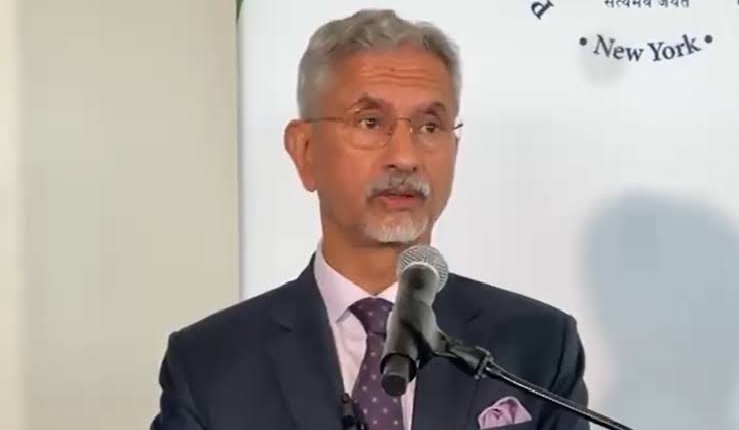
¨ External Affairs Minister S. Jaishankar launched India’s campaign for non-permanent membership of the UN Security Council (UNSC) for 2028–29 and introduced the SHANTI principle.
¨ SHANTI stands for “Securing Holistic Advancement through Norms, Trust and Integrity.”
¨ It means ensuring holistic progress through norms, trust and integrity.
¨ The SHANTI principle reflects India’s global diplomatic vision and commitment to multilateralism.
¨ It highlights the importance of trust, a rules-based international order and global cooperation in India’s foreign policy.
¨ SHANTI can be viewed as a logical evolution of India’s maritime diplomacy.
¨ India’s maritime diplomacy has been shaped by the concepts of SAGAR and MAHASAGAR.
¨ SAGAR (2015) stands for “Security and Growth for All in the Region.”
¨ SAGAR established a vision of inclusive maritime security and equitable development.
¨ It emphasised regional cooperation, capacity building and India’s role as a preferred security partner and first responder.
¨ MAHASAGAR expanded the geographical and strategic scope of the SAGAR vision.
¨ SHANTI seeks to take this vision forward by providing norms and a framework for long-term cooperation.
External Affairs Minister S. Jaishankar launched India’s campaign for non-permanent membership of the UN Security Council (UNSC) for 2028–29 and introduced the SHANTI principle
External
Affairs Minister S. Jaishankar launched India’s campaign for non-permanent
membership of the UN Security Council (UNSC) for 2028–29 and introduced the
SHANTI principle
.jpg)