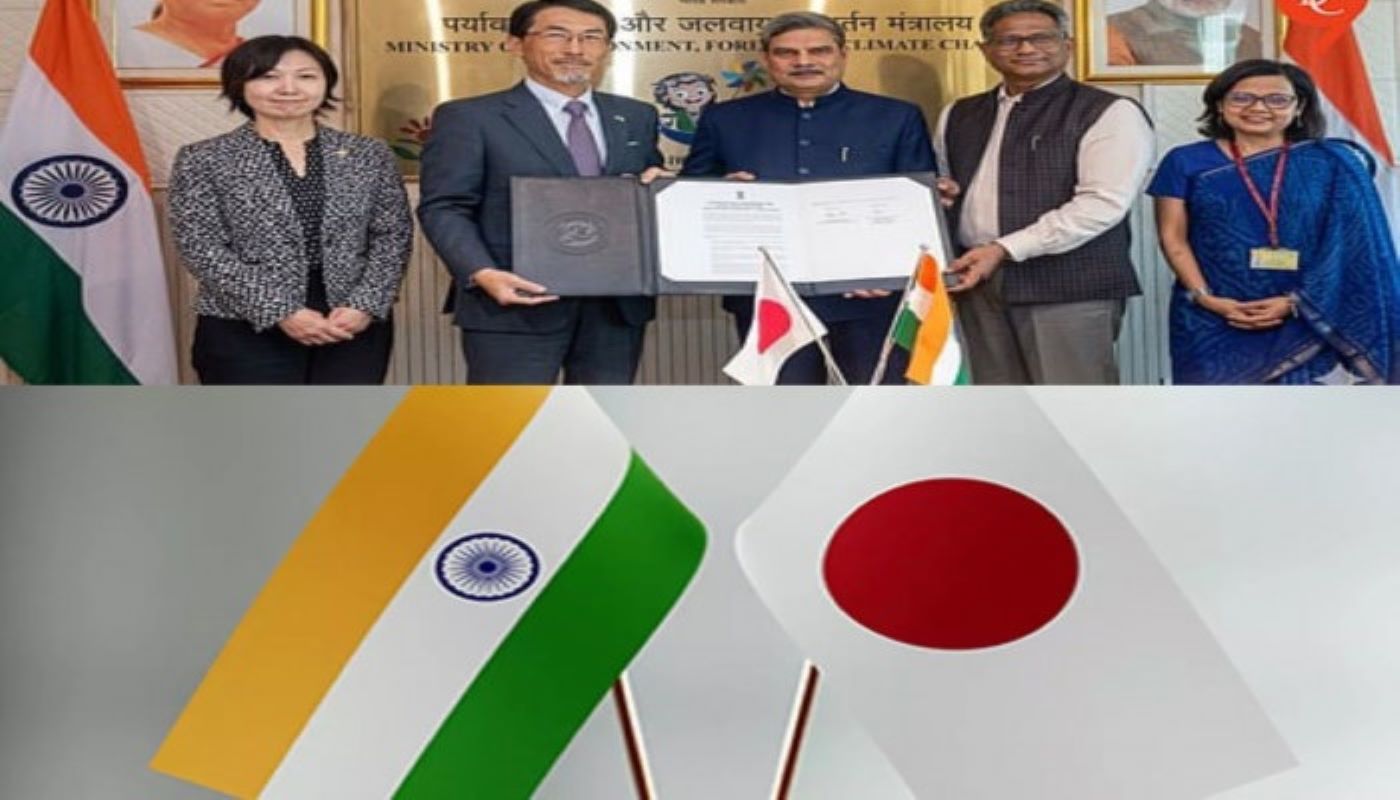
India and Japan adopted the implementation
rules for the Joint Crediting Mechanism under Article 6.2 of the Paris
Agreement
India and Japan adopted the Rules of Implementation of
the Joint Crediting Mechanism (JCM) under Article 6.2 of the Paris Agreement,
establishing an operational framework for bilateral cooperation on greenhouse
gas emission reduction, carbon credit generation, and sustainable development.
Rule of Implementation of the Joint
Crediting Mechanism (JCM)
¨
The JCM is a
project-based bilateral carbon crediting mechanism initiated by Japan in 2013.
¨
It aims to facilitate the
deployment of low-carbon technologies, products, systems, infrastructure, and
mitigation actions that reduce or remove greenhouse gas (GHG) emissions.
¨
India and Japan signed a
Memorandum of Cooperation (MoC) on 7 August 2025 to establish the JCM.
Objectives:
¨
Promote diffusion of
advanced low-carbon technologies in India.
¨
Achieve measurable GHG
emission reductions or removals.
¨
Support sustainable
development in India.
¨
Contribute to the
achievement of the Nationally Determined Contributions (NDCs) of both India and
Japan.
¨
About Article 6.2 of the
Paris Agreement
¨
The Paris Agreement was
adopted in 2015 at COP-21.
It aims to:
¨
Limit global temperature
rise to well below 2°C above pre-industrial levels.
¨
Pursue efforts to limit
warming to 1.5°C.
¨
Countries submit and
implement their Nationally Determined Contributions (NDCs) to achieve these
goals.
¨
Article 6 provides a
framework for international cooperation in climate action, including carbon
markets and non-market approaches.
It contains:
¨
Article 6.2 – Cooperative
Approaches.
¨
Article 6.4 – Mechanism
for Mitigation and Sustainable Development.
¨
Article 6.8 – Non-market
Approaches.
¨
Article 6.2: Cooperative
Approaches
Enables countries to voluntarily cooperate in
achieving their climate targets.Allows transfer of Internationally Transferred
Mitigation Outcomes (ITMOs), commonly referred to as internationally recognized
carbon credits.Functions through bilateral or multilateral arrangements
designed by participating countries.Considered a decentralized framework, with
governance largely undertaken by participating countries rather than the
UNFCCC.Requires robust accounting systems, transparency, environmental
integrity, and corresponding adjustments to prevent double counting of emission
reductions.
.jpg)