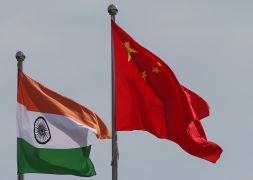
India, China discuss LAC stability,
regional security on SCO sidelines
Defence Ministers’ Meeting of the Shanghai Cooperation
Organisation (SCO) was held in Bishkek, Kyrgyzstan on April 28, 2026, with
India’s Defence Minister Rajnath Singh leading the Indian delegation.The
meeting was attended by defence ministers of all SCO member states, including
India, and focused on regional and global security issues, defence cooperation,
and counter-terrorism coordination.The meeting took place amid rising global
fragmentation, persistent conflicts, and heightened concern over terrorism,
extremism, and regional instability.India used the forum to underline the
importance of regional peace, counter-terrorism cooperation, and defence
collaboration among SCO member states.On the sidelines of the meeting, India
engaged in bilateral interactions with countries such as China and Russia,
discussing issues related to border stability, defence cooperation, and
regional security dynamics.
Shanghai Cooperation Organization
¨ The Shanghai Cooperation
Organization (SCO) is an inter-governmental organization established on June
15, 2001, in Shanghai, China, by its six founding members – China, Russia,
Kazakhstan, Kyrgyzstan, Tajikistan, and Uzbekistan.
¨ It evolved from the
“Shanghai Five”, a grouping formed in 1996 to promote confidence-building and
regional security.
¨ Current Members: The SCO
currently has 10 full members: China, Russia, Kazakhstan, Kyrgyzstan,
Tajikistan, Uzbekistan, India, Pakistan, Iran and Belarus.
¨
In its first-ever
expansion, India and Pakistan were inducted as full members of the SCO at the
2017 Astana Summit.
¨
Iran joined the SCO in
2023, bringing the total number of member states to nine. In 2024, Belarus
became the 10th member state of the SCO.
¨ Decision-Making Bodies:
The highest decision-making group is the Council of Heads of States (CHS),
which meets every year to discuss important issues.
¨ The Council of Heads of
Government (CHG) also meets annually to plan cooperation strategies and approve
the annual budget of the organization.
¨
Permanent Bodies: The SCO
has two permanent bodies:
¨
The Secretariat in
Beijing, which handles daily operations, and
¨ The Executive Committee
of the Regional Anti-Terrorist Structure (RATS) in Tashkent, which focuses on
regional security and counter-terrorism.
¨
Languages: The official
languages of the SCO are Russian and Chinese.
¨ Tourism and Cultural
Capital: The city of Varanasi was nominated as the first-ever SCO Tourism and
Cultural Capital during the period 2022-2023.
Significance of SCO for India
¨
Neutral Platforms for
India- Pakistan/China Dialogue: Multilateral organizations like the SCO create
neutral spaces where India and Pakistan can talk without the usual tensions
that hinder their discussions.
¨ Regional Cooperation:
Since SAARC remains dormant, SCO can serve as an important platform to
collaborate on pressing challenges like climate change, disaster management,
and public health.
¨ Strategic Interests:
Membership in the SCO allows India to strategically address China’s “One Belt,
One Road” and “China-Pakistan Economic Corridor” (CPEC).
¨ Additionally, the
International North-South Transportation Corridor (INSTC) can prove to be of
high significance for India by facilitating connectivity with Russia, Iran, and
Central Asia.
¨ Security Collaboration:
Regional Anti-Terrorist Structure (RATS) helps India in its counterterrorism
efforts by sharing key information and intelligence on the movements of
terrorists and drug traffickers.
¨ Economic Cooperation: SCO
provides opportunities for India to collaborate on infrastructure, energy
projects, and trade initiatives, especially in the resource-rich Central Asian
region.
¨
Projects like the
Turkmenistan-Afghanistan-Pakistan-India (TAPI) Pipeline and the
Iran-Pakistan-India (IPI) pipeline offer mutual benefits and can foster
cooperation, even between rivals like India and Pakistan.
 Bill, 2026.jpg)