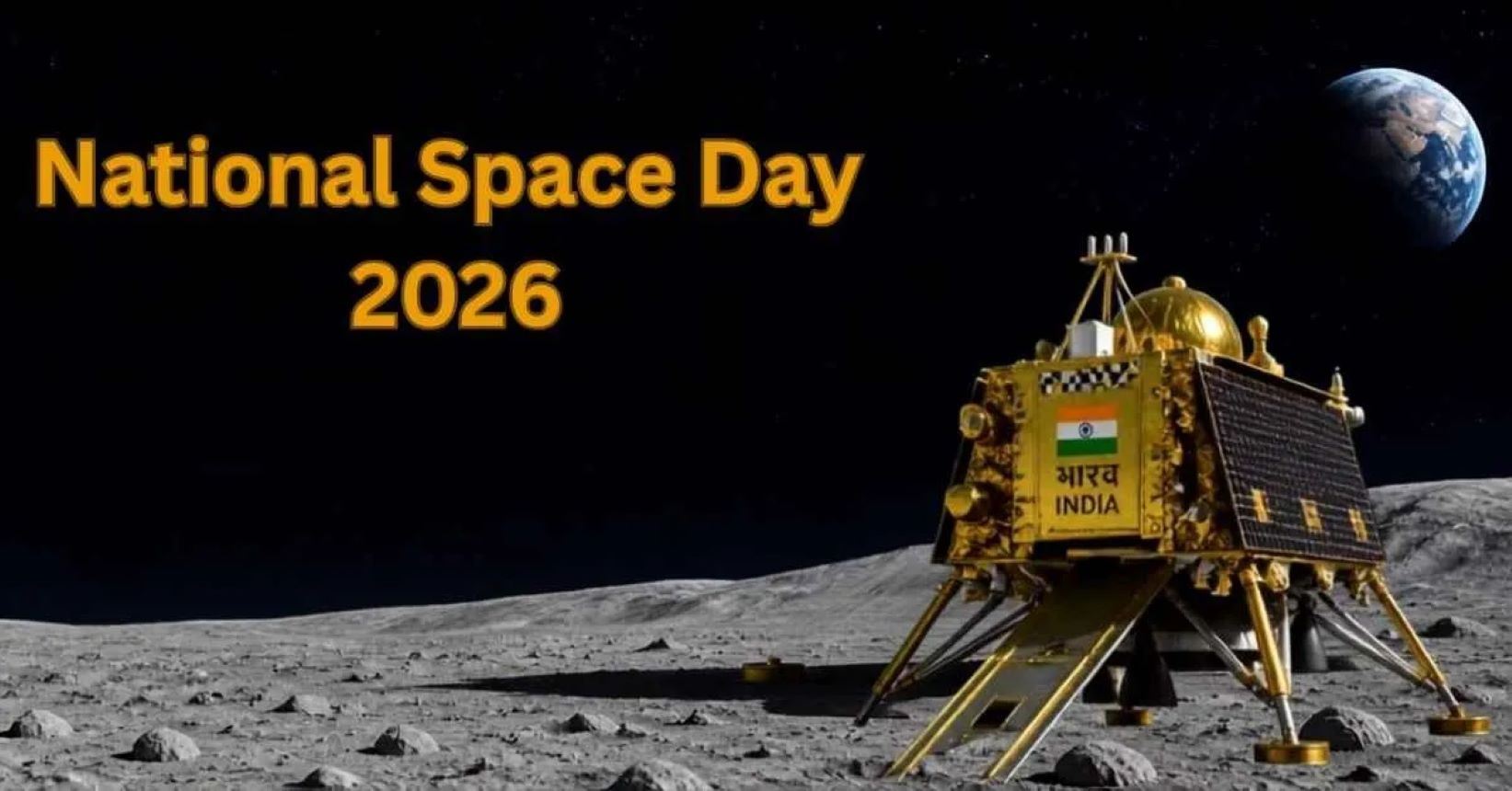
India observes its third National Space
Day on 23 August 2026
India observes its third National Space Day on 23
August 2026, commemorating the historic soft landing of Chandrayaan-3’s Vikram
lander near the lunar south polar region in 2023 and highlighting India’s
expanding capabilities in space science and technology.
National Space Day
¨
National Space Day is
observed every year on 23 August to commemorate the successful soft landing of
the Vikram lander of Chandrayaan-3 on the Moon in 2023.
¨
India became the fourth
country to achieve a soft landing on the Moon and the first to land near the
lunar south polar region.
¨
The landing site was
named Shiv Shakti Point, and Vikram subsequently deployed the Pragyan rover for
scientific experiments.
¨
The theme of National
Space Day 2026 is “Towards Viksit Bharat: Innovating, Collaborating and
Aspiring to Global Space Leadership.” It reflects India’s focus on innovation,
collaboration, self-reliance and greater participation in the global space
ecosystem.
Space Sector in India
¨
Space Ecosystem: India
opened the space sector to private participation in 2020 and introduced the
Indian Space Policy 2023. IN-SPACe authorises and facilitates private-sector
space activities, while NewSpace India Limited (NSIL) commercialises ISRO
technologies and services.India had around 440 registered space start-ups in
2026. IN-SPACe has granted 113 authorisations to 52 Non-Government Entities,
including 18 start-ups.
¨
Space Economy: India’s
space economy was valued at around US$8.4 billion in 2023 and is projected to
reach about US$44 billion by 2033.
¨
Launch Vehicles and
Infrastructure: India operates PSLV, GSLV, LVM3 and SSLV for satellite
launches, space science missions and commercial launches.The Next Generation
Launch Vehicle (NGLV) and reusable launch vehicle technologies are under
development. The third launch pad at Sriharikota and the Kulasekarapattinam
spaceport in Tamil Nadu will expand launch capacity.
¨
NavIC and Space
Applications: NavIC (Navigation with Indian Constellation) provides
positioning, navigation and timing services across India and up to 1,500 km
beyond its borders.Space technology supports agriculture, disaster management,
weather forecasting, water-resource management, healthcare, education,
communication and governance.
Space Missions in India
Lunar Exploration:
¨
Chandrayaan-1 (2008):
India’s first lunar mission; provided evidence of water molecules and hydroxyl
on the Moon.
¨
Chandrayaan-2 (2019):
Advanced lunar exploration through its orbiter and attempted a soft landing
near the lunar south polar region.
¨
Chandrayaan-3 (2023): Achieved
India’s first successful soft landing near the lunar south polar region.
¨
Chandrayaan-4: Planned to
demonstrate lunar sample collection and return to Earth.
¨
LUPEX/Chandrayaan-5:
India-Japan mission aimed at studying lunar polar regions and volatiles,
including water.
Interplanetary and Solar Missions
¨
Mars Orbiter Mission
(2014): Made India the first country to reach Mars orbit on its maiden attempt.
¨
Aditya-L1 (2023): India’s
first dedicated solar mission, positioned around the Sun-Earth L1 point.
¨
Venus Orbiter Mission:
Targeted for 2028 to study Venus’ atmosphere, surface and geological processes.
Space Science and Advanced Technologies
¨
AstroSat (2015): India’s
first dedicated multi-wavelength space observatory.
¨
XPoSat (2024): Strengthened
India’s capability in X-ray polarisation astronomy.
¨
SpaDeX (2025):
Demonstrated autonomous docking and undocking in space, making India the fourth
country to demonstrate this capability.
Human Spaceflight and Space Station
¨
Gaganyaan aims to
demonstrate India’s indigenous human spaceflight capability by carrying three
astronauts to a 400-km orbit for up to three days and safely returning them to
Earth.
¨
The Bharatiya Antariksh
Station (BAS) is India’s planned five-module space station, targeted for
operationalisation by 2035, and is intended to support long-duration human
spaceflight and microgravity research.
Chandrayaan-3
¨
Chandrayaan-3, launched
on 14 July 2023 aboard LVM3-M4, comprised a Propulsion Module, Lander Module
and Rover.
Its three objectives were to
¨
Demonstrate a safe and
soft landing on the Moon.
¨
Demonstrate rover
mobility.
¨
Conduct in-situ
scientific experiments.
On 23 August 2023, Vikram landed at Shiv Shakti Point and deployed the Pragyan rover. The mission studied the lunar surface, thermal properties, seismic activity, plasma environment and elemental composition. APXS detected sulphur near the landing site. The mission’s findings also supported the Lunar Magma Ocean hypothesis. Chandrayaan-3 strengthened India’s capabilities for lunar sample return, human spaceflight, space stations and future planetary exploration