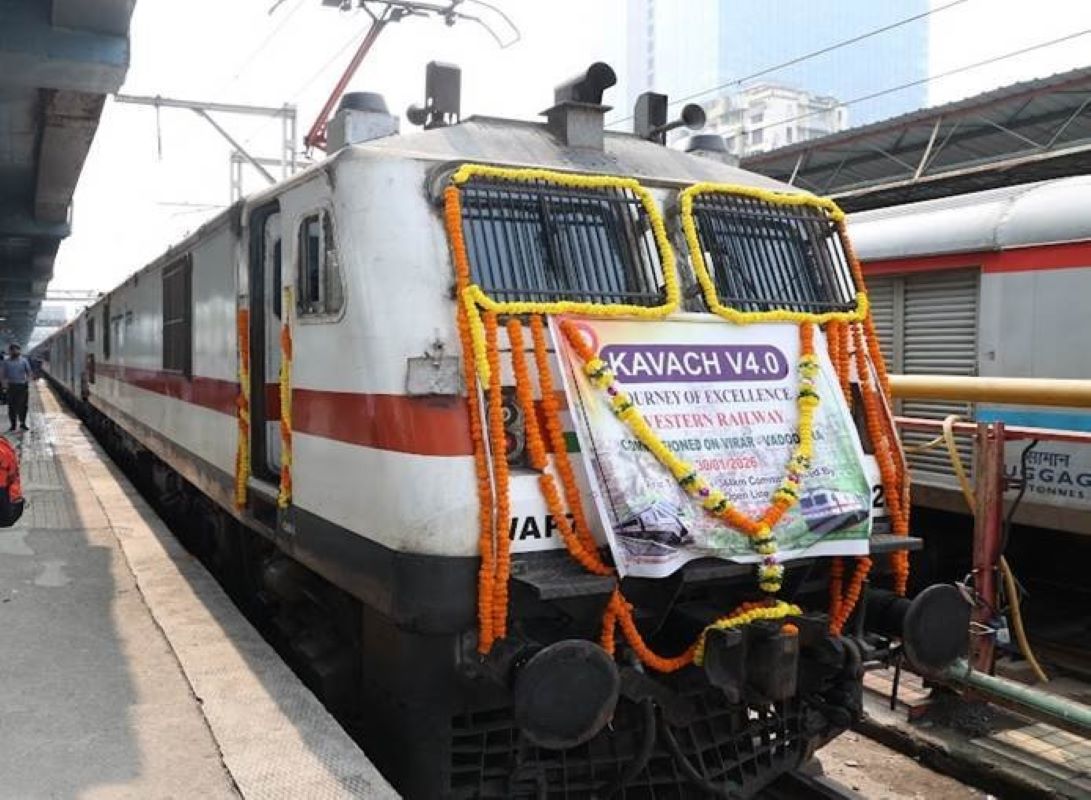
Indian Railways Approves Two Kavach
Projects Worth ₹341 Crore
Indian Railways has approved two Kavach projects worth
₹341 crore to strengthen railway safety and modernise signalling infrastructure
across its network. The projects will cover 1,409 Route Kilometres (RKM),
accelerating the deployment of India's indigenous train protection system and
enhancing operational safety.
More on the News
¨
The projects include ₹201
crore for 811 RKM in Ambala Division and ₹140 crore for 598 RKM in Ahmedabad
Division for the deployment of Kavach 4.0.
¨
The projects are being
implemented under the umbrella programme for the provision of Kavach with an
LTE-based communication backbone across the remaining routes of Indian
Railways.
¨
Kavach rollout is being
prioritised on High-Density Network (HDN) and Highly Utilised Network (HUN)
routes, which together carry the overwhelming majority of railway traffic.
As of March 2026, the progress achieved
are:
¨
3,103 RKM equipped with
Kavach.
¨
767 stations and 4,277
locomotives fitted with the system.
¨
8,570 km of Optical Fibre
Cable (OFC) laid and 1,100 telecom towers installed.
What is Kavach?
¨
Kavach is an indigenously
developed Automatic Train Protection (ATP) system developed by the Research
Designs and Standards Organisation (RDSO) in collaboration with the Indian
industry.
¨
It was initially
developed as the Train Collision Avoidance System (TCAS) and was adopted as the
national ATP system of Indian Railways in 2020.
¨
Kavach 4.0 has been
certified to Safety Integrity Level-4 (SIL-4), the highest level of railway
safety assurance, and it supports train operations up to 160 kmph.
Key Features and Components:
¨
Prevents Signal Passing
at Danger (SPAD).
¨
Automatically applies brakes
to prevent collisions and overspeeding.
¨
Enforces speed
restrictions and assists train operations during fog or low-visibility
conditions.
¨
Provides in-cab signal
information to loco pilots.
Uses an integrated network of:
¨
RFID tags along the
track,
¨
onboard locomotive
equipment,
¨
station-based Kavach
systems,
¨ telecom towers and radio communication,
¨ Optical Fibre Cable (OFC) network.

.jpg)