India’s first geothermal energy project
will be developed in the high-altitude Puga Valley region of Ladakh
India is set to take a major step towards clean and
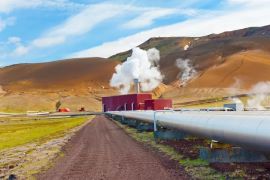
sustainable energy by developing the country’s first geothermal energy project
in the high-altitude Puga Valley region of Ladakh. The project is expected to
strengthen India’s energy security while supporting efforts to reduce carbon
emissions and promote renewable energy sources.
Other Related Information
¨
The Lieutenant Governor
of Ladakh, Vinai Kumar Saxena, has approved a five-year extension of the
Memorandum of Understanding (MoU) with the Oil and Natural Gas Corporation
(ONGC) to develop India's first geothermal energy project in the Puga Valley of
Ladakh, situated at an altitude of over 14,000 feet.
¨
Under this agreement, the
ONGC Energy Centre will establish a 1 Megawatt Electric (MWe) pilot geothermal
energy plant in the Puga Valley of Ladakh, located at an altitude exceeding
14,000 feet.
¨
ONGC will drill up to
1,000 meters into an existing geothermal well and, in the subsequent phase,
will drill an additional geothermal well.
¨
The testing and commissioning
of this pilot plant are estimated to take place during the financial year
2026-27.
¨
The objective of this
project is to lay the groundwork for the large-scale commercial harnessing of
geothermal energy in Ladakh—specifically in the Puga and Chumathang regions of
the Himalayan geothermal belt.
Geothermal Energy
¨
Geothermal energy is
thermal energy (heat) derived from beneath the Earth's crust ("Geo" =
Earth, "Thermal" = Heat).
¨
This heat originates from
the Earth's core and naturally warms underground rocks and water reservoirs.
¨
Wells are drilled into
underground geothermal reservoirs to extract steam and hot water for
electricity generation and direct heating applications.
Key Applications
¨
Electricity Generation:
Steam generated from underground heat drives turbines to produce electricity.
¨
Heating and Cooling:
Geothermal heat pumps are utilized for space heating, cooling, and district
heating systems.
¨
Direct-Use Applications:
These include greenhouse heating, aquaculture, food drying, tourism, industrial
heating, and cold storage facilities.
Sources of Geothermal Energy
¨
High-temperature
geothermal resources are typically found in volcanically and tectonically
active regions, where hot springs, geysers, and underground steam reservoirs
exist.
¨
Based on the temperature
of the underground reservoir, geothermal systems are generally classified into
high, medium, and low enthalpy systems.
¨
In India, geothermal
potential is primarily concentrated in the Himalayan Geothermal Belt, the
Cambay Graben, the SONATA region, the West Coast, and the Andaman and Nicobar
Islands.
Potential in India
¨
India's estimated
geothermal potential is approximately 10,600 megawatts (MW); within this scope,
the Geological Survey of India (GSI) has identified 381 hot springs and 42
potential geothermal sites for power generation and direct-use applications.
¨
The GSI has identified 10
geothermal provinces in India: the Himalayan Geothermal Province, Naga-Lushai,
Andaman and Nicobar Islands, Son-Narmada-Tapi (SONATA), West Coast, Cambay
Graben, Aravalli, Mahanadi, Godavari, and the South Indian Cratonic Province.
¨
The International Energy
Agency (IEA) estimates that India's geothermal market potential will reach 4.2
gigawatts by 2035 and approximately 100 gigawatts by 2045.
¨
Globally, less than 17 gigawatts
of geothermal capacity is currently operational, with the United States,
Indonesia, and the Philippines leading the way. • The National Geothermal Energy Policy (2025) aims to establish
geothermal energy as a key pillar of India’s renewable energy transition, while
supporting energy security and the ‘Net Zero’ target for the year 2070 through
international cooperation, technology transfer, and joint research and
development (R&D).

.jpg)