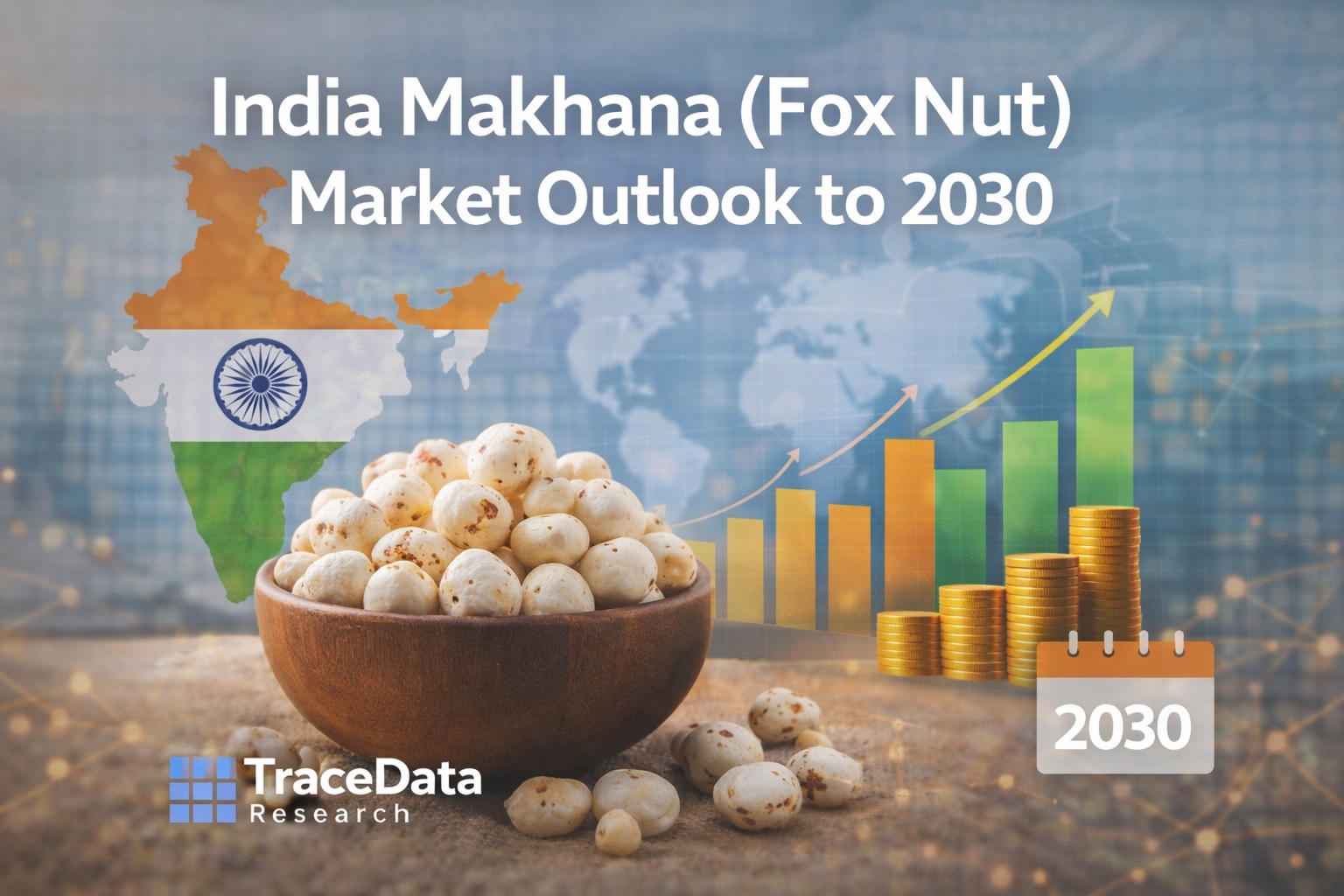
India’s makhana market is projected to reach ₹11,000–12,000 crore by 2029–30. The major factors driving this growth include rising demand, increasing prices, expansion of production and growing interest in health-focused snacks.
Makhana
¨ Makhana is commonly known as fox nut, gorgon nut or water lily seed. Its scientific name is Euryale ferox. It is an aquatic crop whose seeds are processed and roasted for consumption as a food product.
¨ Makhana is mainly cultivated in ponds, wetlands and other aquatic areas. In India, Bihar is the major centre of makhana production.
India’s Status of Makhana
¨ Global and Domestic Position: India is the world’s largest producer of makhana, with cultivation mainly concentrated in Bihar, West Bengal and Assam.Bihar accounts for the overwhelming share of production, particularly in North Bihar, the Kosi basin, Mithila and Seemanchal regions, with major districts including Madhubani, Darbhanga, Saharsa, Katihar, Purnia and Supaul.
¨ Production and Productivity: In 2024-25, India’s makhana production was 63,910 MT, with average productivity of 2.03 MT per hectare, while the Second Advance Estimates for 2025-26 put production at 80,590 MT and productivity at 2.34 MT per hectare.Bihar’s production is estimated at 60,000 MT, with productivity of 2.00 MT per hectare; field-system farming and varieties such as Swarna Vaidehi and Sabour Makhana-1 are improving productivity and reducing cultivation risks.
¨ Domestic Market and Export Potential: The domestic market grew 17–18% annually between 2021-22 and 2024-25 and is projected to reach ₹11,000–12,000 crore by 2029-30, while average prices rose from around ₹500/kg to nearly ₹1,250/kg.In 2025-26, India exported 7,264.89 MT of makhana products worth ₹19,296.08 lakh, with the US, Canada and UAE accounting for 77% of exports, creating scope for stronger export diversification.
Government Initiatives
¨ National Makhana Board, announced in the Union Budget 2025-26 and formally launched in Bihar (Purnea) on 15 September 2025, aims to strengthen the entire makhana value chain covering production, research, processing, value addition, branding, marketing and exports.
¨ The Government has approved a ₹476.03-crore Central Sector Scheme for Development of Makhana for 2025-26 to 2030-31, focusing on research and innovation, quality seeds, farmer skills, harvesting and post-harvest practices, value addition, branding, marketing, exports and quality control.
¨ Makhana Vikas Yojana (Bihar) trains farmers, provides traditional equipment kits at 75% subsidy and promotes improved seeds with subsidies of up to ₹70,000 per hectare.
¨ Rashtriya Krishi Vikas Yojana (RKVY) storage initiative provides 75% subsidy up to ₹7.5 lakh for modern five-MT storage units to reduce post-harvest losses.
¨ The Prime Minister’s Formalization of Micro Food Processing Enterprises (PM-FME) Scheme provides a 35% credit-linked capital subsidy for establishing or upgrading small makhana processing units.
¨ Scheme of Fund for Regeneration of Traditional Industries (SFURTI) organises artisans into makhana clusters and equips them with modern machinery.
¨ The Daak Niryat Kendra at Darbhanga, set up by India Post, supports local makhana producers with export documentation, packaging and shipping, providing a direct logistical link from Mithilanchal to overseas markets.
Significance
¨ Farmer Income: Improved productivity, modern cultivation techniques, value addition and stronger market linkages can support higher farmer incomes.
¨ Rural Employment: Processing, grading, packaging, branding and value-added products can create rural employment and strengthen makhana-based agro-industries.
¨ Export Potential: Growing global demand for healthy, plant-based, clean-label and premium food products provide an opportunity to strengthen makhana as an export-oriented agricultural value chain.
¨ Agricultural Diversification: Makhana’s transition from a traditional pond-based crop to a high-value, branded and export-oriented agri-food product can contribute to agricultural diversification and strengthen India’s agri-food economy.
India’s Makhana Market: Rising Demand, Production and Health-Focused Consumption
India’s
Makhana Market: Rising Demand, Production and Health-Focused Consumption